At my dad’s funeral, my brother said, “She’s just here for the money. Dad’s going to cut her off.”
I knew funerals brought out the worst in people, but I never expected my own brother to weaponize our father’s death. I had barely stepped into the aisle when Brandon’s voice cut through the murmurs, sharp enough to stop the room.
“She’s just here for the money. Dad was going to cut her off.”
Heads turned. Whispers rose.
Heat climbed my neck, but I stood still, refusing to shrink for him. Then the doors opened and the family lawyer walked in holding a small USB. Conversations died.
Breath stalled, because whatever was on that drive wasn’t part of the ceremony. My name is Lily Hartman. And before that day in the church, I used to believe grief softened people.
I thought loss pulled families closer, reminded them of what mattered. But standing there beneath the stained glass windows, listening to Brandon rewrite my entire existence in one sentence, I realized I had been wrong for a long time. It wasn’t always like this between us.
When I was little, Dad woke me before sunrise on Saturdays, whispering, “Grab your boots, kiddo.”
We’d drive toward the water with the windows cracked just enough to let in the smell of salt. He taught me how to tie a line, how to wait without getting restless, how to listen to the quiet. Those mornings felt like the safest place in the world.
Sometimes he’d lift me onto the dock and say, “You see the horizon? That’s how far you get to dream.”
I believed him. But things changed when I chose art over the business path he planned.
I still remember the way his shoulders tensed when I told him I’d accepted a spot at an art school instead of studying finance. He didn’t yell. Dad almost never yelled.
He just went quiet in that way that made the walls go cold. Brandon filled the silence for him. “She’ll grow out of it,” he’d tell relatives, smiling like he was doing me a favor.
“It’s just a phase.”
Except it wasn’t. As I got older, the distance between Dad and me didn’t feel accidental anymore. Calls went unanswered.
Messages disappeared into nothing. I’d send him photos of my work, paintings inspired by the skyline he’d helped build in Boston. And sometimes weeks passed without a reply.
I told myself he was busy, that he didn’t mean it, that we’d fix it later. But later kept slipping away. Moving to New York only made things blurrier.
I tried to visit when I could, but the few times I showed up, Brandon always seemed to be in the middle of a conversation with Dad about some deal or expansion. They’d pause when I walked in, their energy shifting. Brandon would clap my shoulder just a little too hard.
“Still playing with paint?” he’d joke. Everyone laughed except Dad, who just gave me that polite smile strangers give in elevators. By the time Dad’s health began to falter, I didn’t even know.
No one told me. I found out from a distant cousin who assumed I already knew. When I called home, Brandon answered for Dad and said he was resting, that stress wasn’t good for him, and maybe I should give him space.
I tried to believe that, too. But sitting in that church, hearing my brother spit accusations loud enough to echo off stone, something inside me shifted. For the first time, I wondered if the distance I’d been trying to fix wasn’t between me and Dad at all, but between me and the truth.
I stayed in my seat after the service, letting the crowd spill past me in waves of whispered judgment. People I hadn’t seen since childhood avoided my eyes, pretending to straighten jackets or adjust scarves. Brandon didn’t bother pretending.
He stood near the front with Uncle Leonard and Aunt Marissa, speaking just loud enough for his voice to carry across the hall. “She didn’t visit. She didn’t call.
She only shows up now because there’s money on the line.”
Each word landed with the precision of someone who’d rehearsed the narrative for years. Maya squeezed my hand. “You don’t have to stay here,” she murmured.
But I did. Leaving would only prove Brandon right. As I watched him bask in the attention, pieces of the past I tried to ignore began snapping into place.
The unanswered calls, the missing invitations, the time I flew home for Dad’s birthday only to discover the dinner had moved without anyone telling me. I’d cried in a rental car that night, convincing myself Dad was disappointed in me, that maybe I’d pushed too hard, chasing a dream he didn’t understand. Now, watching Brandon smirk under the soft glow of the sanctuary lights, I felt the truth tug hard.
Someone had been feeding Dad a version of me that didn’t exist, and that someone was standing ten feet away, adjusting his tie like he owned the room. When the reception started, I forced myself to walk through it. People parted around me the way water moves around a stone.
A board member from the family business gave me a tight smile. “Your brother handled so much these last few months,” he said. “He stepped up.”
Stepped on was more accurate.
I kept moving. At the refreshment table, Aunt Marissa approached. “It must be difficult,” she said, tone dripping with glassy sympathy, “coming back after being gone so long.”
“I wasn’t gone,” I replied quietly.
She blinked, confused, as if the version of me she’d been handed left no room for contradiction. But the worst moment came when I overheard Brandon telling someone near the doorway, “Dad wanted distance. She made her choices.”
My breath caught.
That wasn’t Dad’s voice. That was Brandon’s. Something inside me broke.
Not in the way things shatter, but in the way steel bends—slow, hot, irreversible. The turning point came when the family lawyer approached me. His expression held something I hadn’t seen all day.
Sincerity. “Lily,” he said softly, “there’s something you should know before tomorrow.”
“Tomorrow?”
“The will reading.”
For the first time since I stepped into the church, I felt a flicker of something that didn’t hurt. Not hope exactly, more like the sense that the story Brandon had been telling all these years was about to meet its first witness.
I barely slept that night. The hotel room felt too quiet, too clean, like a place meant for someone whose life wasn’t unraveling in slow motion. I lay awake replaying every moment of the funeral.
Brandon’s voice cracking through the air, the sideways glances, the lawyer’s unreadable expression. By dawn, exhaustion pressed behind my eyes, but my mind wouldn’t stop moving. Maya knocked just after sunrise, holding two coffees and wearing the sweatshirt she always traveled in.
“You look like you stared at the ceiling for eight hours straight,” she said. “I did,” I admitted. She sat beside me.
“What did the lawyer say yesterday?”
“He didn’t say anything specific, just that I should prepare myself.” I rubbed my temples. “I don’t know what that means.”
“It means something’s coming,” she said. “And not from Brandon.”
Her certainty grounded me more than the coffee did.
By midmorning, I forced myself to walk through the city toward my father’s house, the house I hadn’t set foot in for years. The cold Boston air bit at my skin, carrying the familiar scent of winter and diesel, memories layered on top of each other like paint strokes. When I reached the front steps, I hesitated.
The housekeeper let me in with a soft smile. “Your father spoke of you,” she whispered. It startled me.
“He did?”
She nodded but said nothing more. As she walked away, guilt and longing twisted inside me. Dad’s study looked almost untouched.
Papers stacked neatly. The same heavy wooden chair. A photo of Brandon and me as kids sat on his desk, sunburned from a beach trip, grinning with ice cream melting down our arms.
Beside it, a single empty space where another frame should have been. I stared at that blank spot for a long time. What had been there?
Why was it gone? The quietness of the house felt like a secret breathing against the walls. Back at the hotel, Maya sprawled across the bed, scrolling on her phone.
She sat up when I walked in. “You okay?”
“I don’t know.” I kicked off my boots. “The lawyer said he wanted to speak before the meeting.”
“Speak privately?”
I nodded.
We met in a small office on the top floor of a downtown building that afternoon. Harold Jensen looked worn, like the last few months had carved lines he hadn’t earned. “Lily,” he said gently, “Tomorrow will be difficult for many people in that room.
But not for you.”
“I don’t understand.”
He folded his hands. “Your father made changes, significant ones, and he left context. Context.
You’ll see tomorrow.”
Every answer he gave felt like a locked door. “Harold. Did my dad want distance from me?” My voice cracked despite my best effort.
“Did he… did he stop caring?”
He shook his head immediately. “No. Whatever you’ve been told about your father’s feelings wasn’t from him.”
My breath hitched.
“Then why didn’t he—”
He raised a hand. “Tomorrow.”
It was the only promise he would make. That night, something inside me shifted.
Not hope, not yet, but the beginning of a boundary forming, thin as a line of pencil, but real. And when I finally lay back down, staring at the ceiling of that too-clean hotel room, one thought repeated itself until sleep finally came. Whatever happens tomorrow, I won’t let Brandon speak for me ever again.
I arrived early the next morning, hoping the quiet hallways would steady me. They didn’t. My heart thudded with every echoing step toward the conference room at the end of the long corridor.
Brandon’s voice drifted through the slightly open door, confident, loud, soaked in entitlement. “Dad knew who was loyal. Today, we’ll just make it official.”
My stomach twisted, but I forced myself inside.
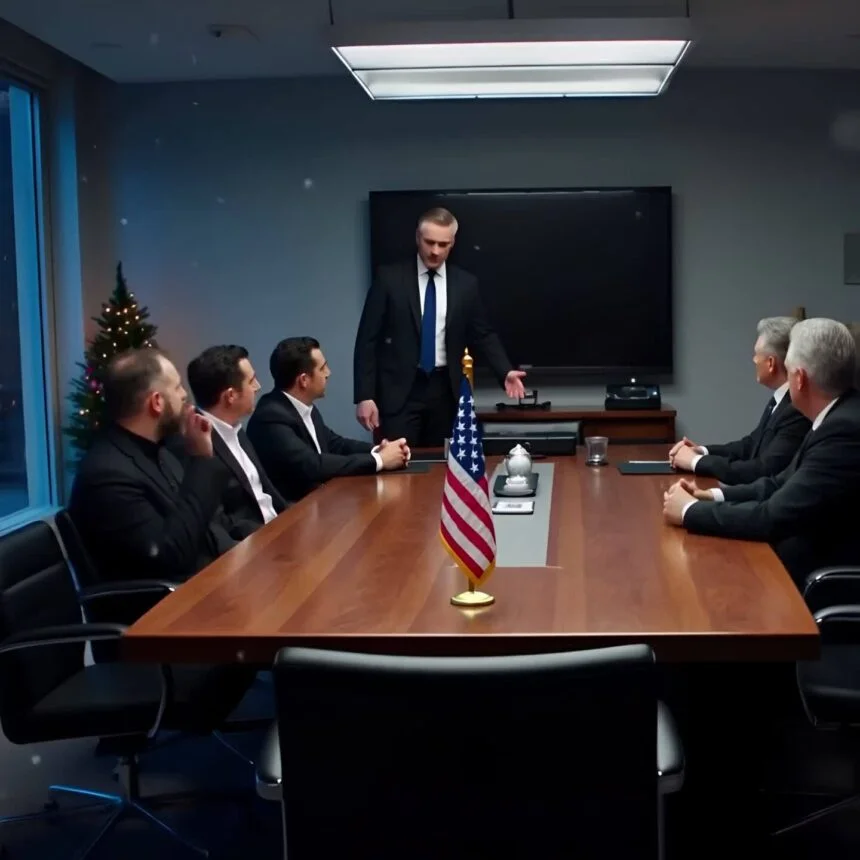
The room fell silent. Every seat at the long table was filled. Board members on one side, relatives on the other, Brandon planted at the head like he’d already taken ownership.
Uncle Leonard gave me a curt nod. Aunt Marissa didn’t bother hiding her disapproval. I walked to the seat farthest from Brandon, the one clearly meant for me, and sat.
Brandon smirked. “You actually showed up. Brave.”
I didn’t answer.
At precisely ten o’clock, Harold Jensen entered, a folder tucked under his arm. But it wasn’t the folder that shifted the room. It was the small USB in his hand.
The same kind he’d carried into the church yesterday. Conversations died instantly. Everyone watched him place it on the table.
“What’s that?” Brandon asked, his tone tightening. “Your father insisted,” Harold said calmly. “We’ll begin shortly.”
Brandon leaned back, trying to regain control.
“Look, Harold, I know Dad wanted me to handle things. So, if this is some sort of sentimental—”
“It isn’t,” Harold said with a finality that surprised even me. He connected the USB to the projector.
The screen at the end of the room flickered to life. Then, my father’s face appeared. My breath caught.
He looked healthy, healthier than he had in years, wearing his navy suit, sitting in his home office, speaking directly to the camera. “Hello,” he said softly. “If you’re watching this, it means I’m no longer here.”
All chairs stilled.
Even Brandon’s smug expression fell flat. “I’ve asked Harold to play this, so there is no confusion, no rewriting of my intentions.”
His eyes were steady and no manipulation. A ripple moved through the room.
“I want to begin with my daughter, Lily, if you’re here.”
His gaze seemed to land on me through the screen. “I’m sorry.”
The word hit so hard I forgot how to breathe. “I’m sorry for the distance between us.
For believing things I should have questioned, for letting others speak for you instead of listening to you myself.”
My vision blurred. “I didn’t blink, but I recently learned the truth,” he continued. “Six months ago, after a health scare, I began working from home.
One afternoon, I went into Brandon’s office to find some documents. There, I found a drawer full of letters addressed to me. Birthday cards, invitations to your art shows, notes you sent over the years.”
Gasps broke around the table.
Brandon shot up from his chair. “That’s a lie,” he said. “Sit,” Harold said sharply.
Dad’s voice pressed on. “All of them hidden from me, all unopened.”
A shocked murmur grew louder. Uncle Leonard frowned.
“Brandon, what is he talking about?”
My father’s face hardened. “That discovery made me question more. I hired a private investigator to review communications, and what I found devastated me.
Calls from Lily intercepted. Voicemails deleted. Messages returned in my name without my knowledge.”
A tremor ran through me.
Brandon’s face reddened. “He was confused. His medication—”
Dad leaned closer to the camera.
“No, son. I knew exactly what I was doing.”
Silence snapped shut. “And the investigation uncovered something even more serious.
Questionable practices inside the company. Cheap materials approved for major developments, altered inspection reports, attempts to push through permits without proper oversight.”
Board members exchanged alarmed looks. One whispered, “My god.”
“I built this company with integrity,” Dad said.
“And what I found forced me to reconsider everything.”
Brandon slammed his hand on the table. “This is ridiculous—”
“Enough,” Harold warned. Dad’s tone softened again.
“Lily, I regret the time we lost. I planned to visit you, to see your life in New York, to make things right. But in case I didn’t get the chance, I wanted you to hear this directly from me.
I am proud of you, of your art, of your courage, of the life you built for yourself.”
My chest broke open. I covered my mouth, the tears unstoppable. “Now,” Dad continued, “as for my estate…”
The room froze.
“My previous will left the majority of my assets and full control of the company to Brandon with a small trust for Lily.”
Brandon straightened, regaining confidence. “That will has been revoked.”
His confidence cracked instantly. “This new document reflects the truth of what I learned.”
Dad picked up a sheet of paper.
“To my son Brandon, I leave a monetary trust of $500,000, released in yearly portions contingent upon his cooperation with an ethics review of his conduct and completion of a business integrity program.”
Brandon choked. “Are you—this is insane. This is fraud.”
Harold didn’t react.
“To my daughter Lily,” Dad said, “I leave my home, my personal investments, and 51% ownership of the company. She may run a point on leadership or sell her shares as she chooses.”
Chaos erupted. Board members whispered furiously.
Aunt Marissa gasped. Uncle Leonard stared at Brandon with something close to disgust. Dad’s voice cut through the noise.
“Lily, I know this is a heavy responsibility, but you have the integrity this company needs. You see the world clearly without cutting corners, and I trust you.”
My throat tightened. Finally, he said, leaning back, “I want to say three words I should have said more often.”
The room went silent.
“I love you.”
Everything inside me collapsed and steadied all at once. He ended with one final message. “Let the truth guide you, and let this company be rebuilt with honesty.”
The screen went black for a long moment.
No one moved. Then Brandon erupted. “This can’t stand.
She doesn’t know anything about the business. She’s an artist. Dad was confused.
Harold, you let him—”
“Enough,” a board member snapped. “You hid communications. You falsified reports.
Do you have any idea how serious—”
Brandon backed away, pale now. “You’re all turning on me.”
“No,” I finally said, standing. My voice surprised even me—steady, quiet, unshaken.
“You did that yourself.”
He stared at me, stunned by the shift in power. All morning he’d acted like the room belonged to him. Now everyone was watching me instead.
“You think you can do this?” he spat. “I don’t have to,” I replied. “Dad already did.”
His jaw clenched.
He looked around, searching for an ally, but every face was stone. For the first time in my life, Brandon looked small. Harold closed the folder.
“We’ll proceed with the formal documents now.”
Brandon stormed out the door, slamming it so hard the glass rattled. No one went after him. The room stayed in stunned silence until someone finally said, “Lily, congratulations.”
I didn’t feel victorious.
Not yet. Just steady. Like for the first time in years, the story was finally mine again.
In the days that followed, everything moved in fragments. Meetings, signatures, hushed conversations in hallways. But beneath all the motion was a strange stillness, like the world had shifted an inch to the left, and I was the only one who noticed.
Harold walked me through the transition with a gentleness I didn’t expect. “Your father thought this through,” he kept saying. “He wanted you to have clarity, not chaos.”
Clarity felt foreign after so many years of doubt.
Moving into Dad’s house was harder than I imagined. The rooms felt familiar and wrong at the same time. His jacket still hung by the door.
A mug sat in the kitchen sink as if he’d meant to rinse it after one more cup of coffee. I stood in the quiet living room, letting the weight of everything press into me. Grief and relief tangled in a way I couldn’t separate.
In his study, I found a small envelope tucked inside his desk drawer, my name written in his handwriting. Inside was a short note, barely a paragraph, but enough to undo me. He wrote that he’d followed my exhibitions from afar, that he admired the way I saw the world, that he wished he’d told me sooner.
I read it three times before I could breathe properly again. At the company, reactions were mixed. Some employees avoided eye contact, unsure of how to treat the artist’s daughter suddenly holding majority ownership.
Others quietly dropped by my new office to say they were relieved there would be changes, real ones rooted in the values my father built everything on. As for Brandon, I heard he’d left Boston for a while. No forwarding address, no apology, and strangely, I didn’t feel anger, just an open road where something new could begin.
Standing on the back porch of my father’s house, I watched the winter light fade across the yard we once built snowmen in. For the first time in years, the quiet didn’t feel heavy. It felt earned.
Dad’s truth had finally broken through. Every lie, every distance Brandon tried to create. And what remained was something simple.
My life was mine again. The company, the house, the legacy. They were responsibilities, yes, but also a chance to rebuild with honesty at the center.
If you’ve ever fought your way back to the truth, share your story below and subscribe for
What I wrote in that caption was the short version, the version that fits into a scrolling feed between dog videos and vacation photos. What I didn’t write, what there was never enough space for, was everything that came after. Because the moment the screen went black and the room finally remembered how to breathe, my life didn’t neatly click into place.
It cracked open in a different way. That afternoon, after everyone filed out of the conference room, Harold lingered. “You should expect noise,” he said quietly as we stood by the window, looking down at the city.
“From the board, from the press, from Brandon. People don’t like their stories rewritten.”
“I noticed,” I said. He studied me for a moment, as if measuring whether to say what came next.
“Your father didn’t choose you because he thought you knew everything,” Harold went on. “He chose you because he finally understood who had been telling him the truth.”
I didn’t know what to do with that, so I just nodded. Maya met me on the sidewalk outside the building, wrapped in a thrifted coat two sizes too big and holding a coffee she’d clearly forgotten was in her hand.
“Well?” she asked. “It played,” I said. She searched my face.
“And?”
“And Dad burned Brandon to the ground on a seventy-two-inch screen,” I said. “Then handed me the matches.”
Maya let out a low whistle. “Remind me never to get on your father’s bad side,” she said.
“You okay?”
I thought about lying. About saying I was fine, that everything was finally fair. “I’m… not sure what I am,” I admitted.
“Relieved. Furious. Sad.
Terrified. All of it at once.”
She looped her arm through mine. “Good,” she said.
“Means you’re still human. Let’s go home.”
Home. The word snagged in my chest.
For the first time, “home” didn’t mean my cramped New York walk-up with paint-splattered floors and a leaky window. It meant a brownstone in Boston with a creaky third step and my father’s jacket still hanging by the door. That night, I didn’t go back to the hotel.
I unlocked the front door of my father’s house and stepped into the dark on my own. The air smelled faintly like his aftershave and old books. I set my suitcase down in the hall and just listened—to the refrigerator hum, to the settling beams, to the far-off siren wailing somewhere in the city.
It reminded me of the nights in my New York apartment when the radiator hissed and the neighbors argued through the walls and I painted until two in the morning because silence felt worse than exhaustion. Here, in this house, the quiet wasn’t empty. It was full of every conversation we didn’t have.
In the kitchen, I opened the cabinet automatically, reaching for a glass in the spot where Mom used to keep them before she died. My chest tightened when I realized Dad had never changed it. Right side, second shelf, third glass from the left.
Still there. I drank water at the sink and stared out at the dark yard. The outline of the old maple tree was still visible against the sky, its branches bare in the winter cold.
When I was eight, Dad had strung Christmas lights through those branches and plugged them in just for me. “It’s art, kiddo,” he’d said, stepping back, hands on his hips. “Light on a canvas of snow.”
He’d remembered I loved art then.
At some point, my legs carried me into his study again. The envelope with my name on it lay where I’d left it, open, his handwriting slanting across the page. I sat in his chair this time.
It was too big, the leather creaking under my weight, the arms wide enough to make my shoulders feel small. I swiveled it gently, letting my eyes trace the edges of the room. The books.
The framed degrees. The photos of ribbon-cuttings and groundbreakings and smiling men in suits. And then, behind a row of binders on the bottom shelf, I saw something.
A corner of a frame, wood chipped on one side. I slid off the chair and crouched down, fingers reaching into the shadow. I pulled out a dusty photograph in a cheap frame.
It was one of my first exhibitions in New York. I recognized the painting in the background—a series of abstract skylines in blues and rust and gold. I stood in front of it in the photo, younger, hair shorter, arms crossed like I was bracing for impact.
Dad stood next to me. I stared at the image, stunned. He had never come to my shows.
That was the story I told myself for years. But there he was, right beside me, wearing the same navy suit he wore in the video, eyes crinkled at the corners, mouth tilted in the hint of a proud smile. The date in the corner was from five years ago.
I sank onto the floor. Five years ago, I had been sure I scanned every face in every tiny gallery and never saw him. I remembered talking to a couple from Brooklyn, a critic from some blog, Maya waving wildly from across the room, and the constant, gnawing disappointment of his absence.
But in this photo, I looked annoyed, mid-eye roll. I tried to reel the memory back, line by line, like sketching from a half-finished drawing. And then it came.
I had been at the bar, nursing a cheap white wine, when a deep voice behind me said, “Looks like you painted the city the way it feels instead of how it looks.”
Without turning around, I’d muttered, “That’s kind of the point.”
“I’m proud of you, kiddo,” he’d replied. I had turned then, heart leaping, but it wasn’t Dad. It was a guy from the building two doors down who’d shown up with his girlfriend.
In that moment, I’d felt foolish for hoping, so I plastered on a smile and shoved the ache down. What I didn’t remember, what I hadn’t noticed, was the man in the background near the door, navy suit, watching quietly. He had been there.
He’d just stayed out of the spotlight the way he always did, letting other people talk for him. My throat closed. “You idiot,” I whispered, but I didn’t know if I meant him or myself.
The next morning, I woke up on the couch with a blanket over me. I didn’t remember pulling it on. The house, for the first time, felt slightly less like a stranger’s.
My phone lit up on the coffee table, buzzing relentlessly. Twenty-three missed messages. Fourteen from unknown numbers.
Three from board members. Two from an area code I recognized as Brandon’s new city, wherever he’d run off to. And one from an unknown number with a Boston prefix that just said, We need to talk.
—L. Chen, Compliance. “That’s fast,” I muttered.
Maya arrived an hour later with a bag of groceries balanced on her hip. “You own a house now,” she said by way of greeting. “You officially have to have more in your fridge than mustard and old takeout containers.”
“I moved in last night,” I protested.
“And the ghost of your father told me you should eat eggs,” she said, breezing past me. She was the only person who could joke about my father without making me flinch. The first few weeks felt like trying to paint with someone else’s hands.
There were meetings I didn’t understand, terms I had to write down phonetically so I could Google them later. Harold sat beside me in boardrooms, quietly sliding notes my way when he saw panic flicker in my eyes. “Cap rates,” one note said in his neat handwriting.
“Think of them like the value of the building’s income stream. We’ll go over later.”
“EBITDA,” another read. “Ugly word.
Basically, money before you count the expensive boring stuff.”
I was an artist dropped into a world of spreadsheets and steel beams. But the strange thing was, the more I listened, the more it felt like a different kind of composition. Buildings had rhythm.
Budgets had balance. Projects had negative space where risk lived. One afternoon, after a meeting that ran two hours over, I found myself in the break room with a structural engineer named Daniela.
“So you’re the infamous artist,” she said, stirring sugar into her coffee. “Infamous already?” I asked. “You ousted a Hartman from his own company via dead man’s video,” she said dryly.
“You’re a legend.”
I winced. “That wasn’t me,” I said. “That was my father finally telling the truth.”
She studied me for a long moment.
“You know what I like about this?” she said. “He didn’t give the company to another version of himself. He gave it to someone who might actually see what the rest of us see every day.
The corners he didn’t cut, the ones Brandon tried to.”
She set her mug down. “Come to the site visit tomorrow,” Daniela added. “You should see what you’re in charge of when it’s just rebar and mud.”
The next day, I stood in the middle of a construction site in a hard hat that felt like it did not belong on my head.
Cold wind whipped through the skeleton of what would one day be a mixed-use tower. Men shouted measurements. A crane groaned somewhere above us.
The air smelled like wet concrete and exhaust. Daniela handed me a pair of safety glasses. “Your brother signed off on cheaper concrete for this job,” she said.
“Your dad halted the pour when he found out. He didn’t tell the board about it yet, but he told me. Said if it happened again, he’d burn the place down before he let it stand.”
I looked at the columns rising around us, at the steel bars jutting toward the cloudy sky.
“If he’d passed before he caught it…” I began. “We’d have a very pretty, very unstable tower full of people one earthquake away from disaster,” she finished. My stomach turned.
“He made the right call,” I said. “He did,” she replied. “Question is, will you?”
The question followed me all the way home.
That night, as I sat at Dad’s old desk with my laptop open and three different reports pulled up, my phone lit up with a number I didn’t recognize. For a moment, I considered ignoring it. But something in my gut told me to answer.
“Hello?” I said. Static crackled, then a voice I knew as well as my own. “So this is what it takes for you to pick up your phone,” Brandon said.
Every muscle in my body tensed. “What do you want?” I asked. “I want my life back,” he snapped.
“I want my company, my position, my future. All of which you stole.”
I closed my eyes for a second, steadying my voice. “Dad made his own choices,” I said.
“You made yours.”
“Dad was sick,” Brandon shot back. “Confused. Harold and his cabal of yes-men manipulated him.
And you—you swooped in with your starving artist routine and played the victim.”
“Is that what you tell yourself?” I asked quietly. “When you were intercepting my calls? Hiding my letters?
Signing off on cheap concrete?”
There was a beat of silence. “You don’t know anything about how this business works,” he said finally. “You never wanted it.”
“Maybe I didn’t want it the way you did,” I replied.
“As some kind of birthright. But wanting something and deserving it aren’t the same thing.”
His laugh was low and mean. “You’re going to regret this, Lily,” he said.
“When the board realizes you don’t have a clue. When the press starts circling. When the first project goes sideways and they need someone to blame.”
“They already had someone to blame,” I said.
“You just walked out of the room before you could hear it.”
He cursed under his breath. “You think that video is the end of it?” he sneered. “You have no idea what Dad was like at the end.
No idea what he’d say if he were here in person instead of some edited speech Harold spoon-fed you.”
Cold slid down my spine. “That was him,” I said. “His words.
His face. His choice.”
“We’ll see what a judge thinks,” Brandon replied. “Hope you like lawyers as much as you like oil paint.”
The line went dead.
I stared at the phone for a long time. When I finally told Harold about the call the next day, he didn’t look surprised. “He’s contesting the will,” Harold said.
“Of course he is.”
“Can he win?” I asked. Harold took off his glasses and cleaned them with a cloth he pulled from his pocket, buying himself a moment. “He can make things loud,” he said.
“Messy. But your father’s documents are solid. There are medical evaluations, video statements, dated amendments.
Brandon underestimated how thorough your father could be when he finally decided to act.”
I exhaled slowly. “So we just… wait?” I asked. “We prepare,” Harold corrected.
“And you keep doing the one thing Brandon never did—show up.”
Showing up turned out to be more exhausting than any ten-hour painting session. There were early-morning calls with project managers, mid-day walkthroughs with city inspectors, late-night emails about supply chain delays and cost overruns. I sat through media training so I wouldn’t freeze the first time a reporter shoved a microphone at me.
“Just speak like you did in there,” the media coach said after watching a recording of me answering a board member’s aggressive question. “Calm. Clear.
No apology for existing in the room.”
“Easier when the room doesn’t have six cameras and a chyron,” I muttered. Maya found it all hilarious. “You’re going to be on local news,” she crowed one night, flopping onto my couch.
“Can I come over and critique your blazer choice live?”
“Absolutely not,” I said. “Also, I don’t own a blazer.”
She stared at me. “You inherited a company and you don’t own a blazer?” she asked.
“I have a very nice paint-splattered denim jacket,” I offered. The next day, a box arrived at the house addressed to me. Inside were two blazers—one black, one deep blue—and a note in Harold’s handwriting.
You don’t have to look like your father to lead like him. But a decent blazer doesn’t hurt. —H.
I laughed so hard I cried. The first time I walked into a press conference as “Lily Hartman, majority owner and acting chair of Hartman Development,” I thought my legs might actually give out. There were cameras.
Flashbulbs. A row of microphones lined up on a table like accusing fingers. Harold spoke first, laying out the facts of the transition, the ethics review, the independent audit my father had ordered before he died.
Then it was my turn. “Ms. Hartman,” a reporter called out.
“Did you manipulate your father into changing his will?”
The question hit like a slap. I saw how easy it would be to shrink. To let Harold answer for me.
To let someone else narrate. Instead, I leaned into the microphone. “My father was manipulated for years,” I said evenly.
“But not by me. He made his decisions after seeing the truth about what was happening inside his company and his family. I wish he’d seen it sooner.
I wish we’d had more time. But I won’t apologize for him choosing integrity over convenience.”
Another reporter shouted a question about Brandon’s accusations, about the “artist daughter” with no business degree running a development firm. “You’re right,” I said.
“I’m not my father. I’m not my brother. I’m not a traditional CEO.
I’m an artist who grew up watching the skyline of this city rise building by building. I care about what we put into that sky. If you’re worried about my qualifications, good.
You should be worried about anyone who holds this much power. That’s why we’re opening our ethics review to an independent panel and publishing our findings.”
The room buzzed. When it was over, my hands shook so hard it took three tries to unclip the microphone from my blazer.
Maya met me backstage, eyes wide. “You just told a room full of reporters to stay worried about you,” she said. “That’s either the dumbest or the bravest thing I’ve ever seen.”
“I’m going with necessary,” I replied.
At night, when the house finally went quiet and the emails slowed to a trickle, I painted. I turned Dad’s old guest room into a studio, spreading drop cloths over the hardwood and propping canvases against the walls. The first piece I finished after the video will was not subtle.
It was a cityscape split down the middle. On one side, clean lines, balanced beams, windows reflecting an honest sky. On the other, hairline fractures running through concrete, hidden behind a glossy facade.
In the middle, a thin figure stood with her back to the viewer, hands at her sides, facing the fracture line. When I stepped back, paint still drying, I realized the figure looked a lot like me. One weekend, months into the transition, I got an email from the compliance head, L.
Chen. Subject line: Findings. “You should read this in person,” she wrote.
I met her in a windowless conference room on the twelfth floor. She was younger than I’d expected, maybe mid-thirties, black hair pulled into a low bun, expression steady. “We traced every financial irregularity your father flagged,” she said, sliding a thick file across the table.
“And then some. Your brother was creative. I’ll give him that.”
I flipped through the pages—shell companies, inflated invoices, kickbacks disguised as consulting fees.
“How bad is it?” I asked. “Bad enough that if this ever hits without you getting ahead of it, the narrative becomes ‘family feud covers up corporate fraud,’” she said bluntly. “Good enough that if you act now, cooperate fully, and hold people accountable, you come out as the company that chose to clean its own house.”
“And Brandon?” I asked.
“If the DA decides to move forward, he’ll have bigger problems than losing his chair at the table,” she replied. For a long moment, I stared at the file. This was it.
The moment my father’s last wishes left the safety of a USB drive and collided with the real world. “Do it,” I said. “Whatever it takes to fix this.
We disclose what we have to disclose. We cooperate. We rebuild.”
L.
Chen nodded once. “You’ll take a hit in the short term,” she warned. “Stock price.
Reputation. The gossip will be brutal.”
“It already is,” I said. “At least this way, it’s true.”
A week later, as the first stories broke about “financial irregularities under former executive Brandon Hartman,” my phone buzzed again.
Brandon. I let it go to voicemail. His message was short, voice ragged in a way I had never heard.
“You think this makes you better than me?” he said. “Enjoy your little crusade, Lily. When they come for me, they’ll come for you, too.”
He wasn’t entirely wrong.
When your last name is carved into steel on half the buildings downtown, there’s no such thing as clean distance. But as I stood in the lobby of one of our oldest properties, watching tenants come and go, I felt something I hadn’t felt since before the distance with Dad began. Purpose.
Not the kind Brandon had, fueled by conquest and control. Something quieter. Heavier.
The knowledge that what I did with this power could keep people safe in ways they’d never see. One evening, months after the video, I sat on the back steps of the house with a mug of tea between my hands. Snow had started to fall again, flakes catching in the porch light.
Maya stepped outside, wrapping her arms around herself. “You know there are chairs inside, right?” she said. “I like it here,” I replied.
“It reminds me of those mornings on the dock with Dad. Before everything got complicated.”
She sat beside me, bumping my shoulder with hers. “It’s still complicated,” she said.
“But you’re handling it.”
“Some days it feels like it’s handling me,” I admitted. She was quiet for a moment. “Do you ever miss it?” she asked.
“New York. The chaos. The bad coffee.
The landlord who refused to fix your window.”
“Every day,” I said. “And not at all.”
She laughed softly. “Very clear answer,” she teased.
“I miss painting all day and worrying only about my own mess,” I said. “I miss being anonymous. But I don’t miss the feeling that I was shouting into a void, that the person whose opinion mattered most had decided I wasn’t worth seeing.”
“He saw you,” she said quietly.
I looked down at my hands, remembering the hidden photo, the letters he’d never read, the note he’d left. “Yeah,” I said. “He did.
Just later than I wanted.”
We watched the snow fall for a while. “What are you going to do with it?” she asked eventually. “With what?”
“All of it,” she said, waving her hand vaguely toward the house, the skyline, the life that had landed in my lap.
“The company. The money. The legacy.”
I thought about Brandon’s voice at the funeral, about the way people had looked at me like I was a thief walking into my own father’s goodbye.
I thought about the boardroom, the construction sites, the compliance files. “I’m going to make sure the buildings stand,” I said slowly. “I’m going to make sure the people inside them are safe.
I’m going to put art in the lobbies and light in the stairwells and pay the contractors what they’re worth.”
I took a breath. “And when the company is finally what my father thought it was before he saw the cracks,” I added, “maybe I’ll sell my shares and open a gallery. Or a foundation for young artists who don’t have fathers who can pay for art school.
I don’t know yet.”
Maya smiled. “Whatever you do, it’ll be loud and inconvenient for people who like the status quo,” she said. “Which means I’ll probably love it.”
In the months that followed, the noise never really stopped.
There were hearings. There were depositions. Brandon’s legal team threw every accusation they could at the will, at Harold, at me.
They lost, slowly and bitterly, in motion after motion. I saw my brother twice. Once, across a courtroom, his jaw clenched, eyes hollow.
Once, by accident, on a street near the courthouse as he stepped out of a building. He froze when he saw me. For a moment, we were just two kids again in salt-sticky T-shirts, standing on a dock while Dad pointed at the horizon.
“You got what you wanted,” he said finally. “No,” I replied. “I got what Dad decided I could be trusted with.
There’s a difference.”
“Do you feel better?” he asked. It was such an honest question that it startled me. “Sometimes,” I said.
“Sometimes I feel like I’m trying to fix a painting after the paint’s already dried.”
He huffed out a humorless laugh. “You think this is fixing things?” he asked. “It’s the only way I know how,” I said.
He opened his mouth like he wanted to say more, then shook his head and walked away. I watched him go, the wind tugging at his coat. I didn’t call after him.
I didn’t forgive him. Not then. Maybe not ever.
But for the first time, I didn’t feel like the little sister chasing after his back, begging to be let into a world he controlled. I turned and walked the other direction. Back at the house that night, I sat at Dad’s desk and opened a blank document.
My cursor blinked at the top of the page. Title: Hartman Development—Code of Ethics. I wasn’t a lawyer.
I wasn’t a CEO in the traditional sense. But I knew what it felt like to have your story stolen and rewritten. So I started there.
We will not hide the truth to protect our pride. We will not cut corners to save a dollar today that might cost a life tomorrow. We will not silence the people who tell us what we don’t want to hear.
We will build like we mean it. The words poured out, simple and clear. Later, I would send the document to Harold and L.
Chen and Daniela and a dozen other people smarter than me to refine it, to add clauses and legal language and references. But the bones of it, the part that mattered, were mine. When I was done, I printed a copy and taped it to the wall above my easel in the studio.
Art and ethics, side by side. Different mediums. Same intention.
Some nights, when the house is finally still and the city hums low outside, I stand at the back door and look out at the yard. I think about that little girl on the dock, boots too big, eyes on the horizon. “That’s how far you get to dream,” Dad had said.
For a long time, I thought he’d stopped believing that about me. Now I know the truth. He’d just been looking in the wrong direction.
So if you ever find yourself sitting in a room where someone is rewriting your story, remember this:
You are allowed to take it back. Even if it takes a lifetime and a video on a USB drive. Even if your voice shakes when you finally say, “No.
That’s not who I am.”
Especially then. If you’ve ever fought your way back to the truth, share your story below and subscribe for whatever comes next, because I’m still figuring it out, one hard conversation, one steel beam, one brushstroke at a time.
