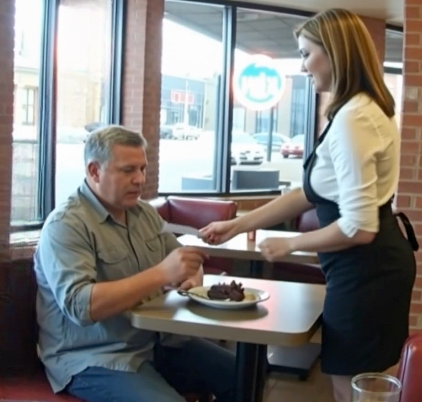
The steakhouse glowed warmly from the outside, its golden signage reflecting against the evening pavement like a promise. Inside, the lighting was deliberately low—soft amber tones meant to slow conversations and encourage guests to linger over thick-cut steaks and expensive wine. To most people dining there, the restaurant felt like a refuge from the world outside.
To Daniel Whitmore, it felt like a test.
Every step he took across the polished floor carried weight. Not because anyone recognized him—few did—but because he knew why he was really there. This wasn’t a casual dinner stop or a routine inspection announced weeks in advance. This was something else entirely.
Daniel adjusted the cuff of his jacket and let his gaze drift across the dining room. Tables were full. Laughter rose in gentle waves. Servers moved with trained efficiency, balancing plates and smiling on cue. From a distance, everything looked exactly as it should.
That was the problem.
Appearances had a way of lying.
His hand brushed against his pocket, where a small folded note rested. Six words. That was all it contained. Six words that had followed him across three states and refused to let him sleep the night before.
Please come tonight. You need to know.
The note had been slipped to him earlier that day by a young hostess who hadn’t met his eyes. She’d said nothing else, only nodded once before disappearing back into the flow of customers.
Daniel hadn’t needed more.
He stopped near the edge of the dining room, just short of a plain door marked EMPLOYEES ONLY. From here, he could still see everything—the couples leaning toward one another in quiet conversation, the family celebrating a birthday near the window, the regulars seated at their usual corner table.
Bryce was there too.
The manager stood with practiced ease near the bar, laughing with a middle-aged couple Daniel recognized from quarterly reports. Bryce had a presence—tall, broad-shouldered, confident in a way that suggested control. On paper, he was exceptional. Sales were steady. Costs were down. Customer complaints were minimal.
Corporate loved him.
Daniel didn’t trust him.
Men like Bryce knew how to perform. They understood which numbers mattered and which stories to tell. And too often, they built success by squeezing the people beneath them until there was nothing left to give.
Daniel had built his business from nothing. He’d worked the grill himself once, burned his hands, pulled double shifts, learned every position because he had to. He’d promised himself long ago that if he ever made it to the top, he would never forget what it felt like to stand at the bottom.
That promise had brought him here.
After one last look at the dining room, Daniel pushed the door open and stepped through.
Behind the Scenes
The temperature dropped immediately.
Gone were the warm lights and soft music. The hallway beyond the door was narrow, functional, and bright with harsh fluorescent bulbs. Stainless steel surfaces lined the walls, reflecting distorted images of movement. The hum of industrial refrigerators vibrated faintly through the floor.
This was the real heart of the restaurant.
Daniel moved slowly, letting his senses adjust. The clatter of the kitchen sounded distant now, muffled by thick walls. Somewhere, water ran steadily. A timer beeped and was quickly silenced.
At the far end of the corridor stood a woman.
She waited beneath the stark overhead lights, hands clasped tightly in front of her. Her posture was straight, but tension pulled at her shoulders. When she looked up and saw him, something shifted in her expression—relief, quickly followed by resolve.
“Mr. Whitmore,” she said quietly.
“Daniel,” he corrected gently. “Thank you for asking me to come.”
She nodded, glancing briefly toward the kitchen door as if half-expecting someone to appear. “I didn’t want to cause trouble. But I couldn’t stay silent anymore.”
Daniel studied her carefully. Jenna, according to the employee roster. Twenty-four years old. Two years with the company. Good performance reviews until recently, when her file showed a sudden lack of commentary—no praise, no criticism. Just silence.
“Start from the beginning,” Daniel said. “Tell me what’s really going on here.”
Jenna took a slow breath. “It’s Bryce. The way he runs this place… it’s not right.”
Cracks Beneath the Surface
Her words came cautiously at first, as if she were testing the ground beneath her feet.
“He cuts staff wherever he can,” she explained. “Schedules look fine on paper, but people are constantly stretched too thin. We’re expected to cover two positions at once, sometimes three. If someone calls in sick, he tells us to ‘figure it out.’”
Daniel nodded, his expression unreadable.
“He pressures the kitchen to rush prep,” Jenna continued. “Quality suffers. We know it does. But if we speak up, he reminds us how easy we are to replace.”
Her voice tightened slightly. “He plays favorites. If you don’t fit his idea of a ‘team player,’ your hours disappear. Write-ups come out of nowhere. People stop smiling. They stop caring.”
Daniel felt a familiar heaviness settle in his chest.
“And corporate?” he asked.
Jenna let out a short, humorless laugh. “He knows how to talk to them. He stages everything when inspectors come. Extra staff on the floor, fresh supplies, suddenly everyone’s treated like gold. The rest of the time…” She shook her head. “It’s different.”
Daniel thought of the reports he’d read—numbers that looked just good enough to avoid scrutiny. Turnover rates explained away by “market trends.” Exit interviews that revealed nothing because employees were afraid to be honest.
“Why didn’t anyone report this sooner?” he asked quietly.
“Because we need these jobs,” Jenna said simply. “And Bryce makes sure we know it.”
A Familiar Pattern
As Jenna spoke, Daniel felt pieces clicking together.
This wasn’t an isolated issue. He’d seen versions of this story before, in other industries, other companies. A manager who delivered results at any cost. A system that rewarded numbers without listening to voices.
When he’d started his first steakhouse, it had been just him and a small team. They’d shared meals after closing, laughed through exhaustion, celebrated small wins together. The business grew because people cared.
Somewhere along the way, growth had made things complicated.
“What about the rest of the staff?” Daniel asked. “Do they feel the same way you do?”
Jenna hesitated, then nodded. “They’re good people. Hardworking. But they’re tired. Burned out. Some of the best servers we’ve ever had have quit quietly, without complaints, because they didn’t think anyone would listen.”
Her voice dropped. “We used to be proud to work here.”
That statement landed harder than any accusation.
Daniel exhaled slowly. “You did the right thing by reaching out.”
Jenna looked up at him, surprise flickering across her face. “I was afraid you’d think I was exaggerating. Or that I was just complaining.”
“I know the difference,” Daniel said firmly. “And I know what happens when leaders forget who they’re responsible for.”
The Weight of Responsibility
They stood in silence for a moment, the hum of machinery filling the space between them.
Daniel understood what Jenna had risked by speaking up. In workplaces like this, truth often came with consequences. Retaliation didn’t always look dramatic—it could be as subtle as fewer shifts, colder interactions, or being pushed out slowly.
“You won’t face any backlash for this,” Daniel said. “I give you my word.”
Her shoulders eased slightly. “Thank you.”
“But I need to see it for myself,” he added. “I can’t rely on one perspective, even when I believe it.”
Jenna nodded. “I understand.”
He glanced toward the kitchen door. “Go back to your shift. Act like this conversation never happened.”
“What will you do?” she asked.
Daniel’s gaze hardened—not with anger, but with purpose. “I’ll make sure this place becomes what it was meant to be.”
Observing from the Shadows
For the rest of the evening, Daniel blended into the background.
He watched how Bryce interacted with staff—quick smiles that didn’t reach his eyes, sharp whispers delivered with a friendly pat on the shoulder. He noticed how servers avoided certain areas, how the kitchen staff moved with tension rather than rhythm.
He spoke quietly with employees during brief moments—asking neutral questions, listening carefully. No accusations. Just observations.
Patterns emerged.
By the time the dinner rush slowed, Daniel had seen enough.
The Confrontation
The following morning, Daniel returned—this time announced.
Bryce greeted him with enthusiasm, extending a hand and launching into a rehearsed overview of performance metrics. Sales projections. Cost controls. Efficiency improvements.
Daniel let him talk.
Then he asked questions.
Specific ones.
About turnover. About training gaps. About why three employees had quit within the last month without exit interviews on file. About scheduling discrepancies that didn’t align with payroll data.
Bryce’s confidence wavered.
By the end of the meeting, the truth was unavoidable.
Daniel’s voice was calm when he spoke. “This location will be under new management effective immediately.”
Bryce protested. Rationalized. Blamed others.
Daniel listened, then stood. “Leadership isn’t about squeezing results out of people. It’s about creating an environment where they can succeed without fear.”
Security escorted Bryce out quietly.
Rebuilding What Was Broken
Change didn’t happen overnight.
But it began.
Daniel stayed involved personally for weeks. He brought in an interim manager known for integrity. He reinstated training programs, adjusted staffing levels, and encouraged open communication.
Most importantly, he listened.
Jenna watched the transformation with cautious optimism. Slowly, laughter returned to the break room. Smiles felt genuine again. Pride resurfaced.
One evening, as Daniel prepared to leave, Jenna approached him.
“Thank you,” she said simply.
He smiled. “Thank you for reminding me why this matters.”
A Quiet Victory
The steakhouse still glowed warmly from the outside.
But now, behind the kitchen door, something had changed.
The air felt lighter.
And Daniel Whitmore walked away knowing that leadership wasn’t measured in profits alone—but in the courage to face uncomfortable truths and the willingness to protect the people who make success possible.
