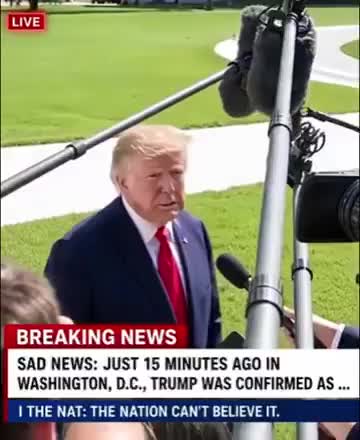
The Facebook reel opens with a clip of Donald Trump and a television-style banner suggesting a late-breaking development in Washington. The article linked by the reel takes readers to an account of a speech and a pause. It provides no date or named venue for that speech, and the reel supplies no primary recording that connects its banner to the event described in the article.
The detail about Washington is too broad to establish what happened. A president may be in Washington for several public and private engagements in a single week. A clip may show a photograph or a few seconds from one event while the text refers to another. Establishing the date of an image and establishing the date of the headline are separate tasks.
The linked article frames a moment of silence as politically significant. The account relies heavily on descriptions of how the audience felt and how commentators were supposedly reacting. It leaves out the basic details a reader would need to identify the address. The reader cannot tell what was on the schedule, who attended or whether there is a transcript that would place the pause in context.
An archive of presidential remarks can sometimes resolve this kind of question. A dated transcript can show what was said immediately before and after a widely shared excerpt. A full video may show whether a pause was part of the speech, a question from the audience, or simply a break in the recording. Without identifying details, it is difficult to match the few seconds in a post to a particular event with confidence.
The short video also combines several different signals. There is the visible image of Trump, a red label and a line of text announcing an urgent event. A viewer may naturally assume those parts all came from one documented news broadcast. They can instead be elements of a social media edit. A television-style layout is straightforward to add to a clip and by itself supplies no information about where the footage originated.
Shared posts often use time phrases that make sense only at the moment somebody writes them. A clip that says something occurred minutes ago can remain in circulation for days. Readers may encounter it in a feed where the original sharing date is difficult to find. That is one reason reporting about a specific event should identify a calendar date and place before relying on words such as today or just now.
The article may invite readers to discuss how a public figure uses silence in a speech. That is an interpretation. The claims about an identifiable announcement in Washington call for evidence of the underlying event. The link gives a dramatic narrative without giving readers the details needed to make that connection.
The available material therefore supports a narrow conclusion. The reel shows footage of Trump with a dramatic caption, and the linked page describes a pause in an unspecified address. It does not establish that the two describe the same occasion or document an urgent new development in Washington. The useful information would be the complete event recording or a dated source identifying the venue and explaining the occasion.
