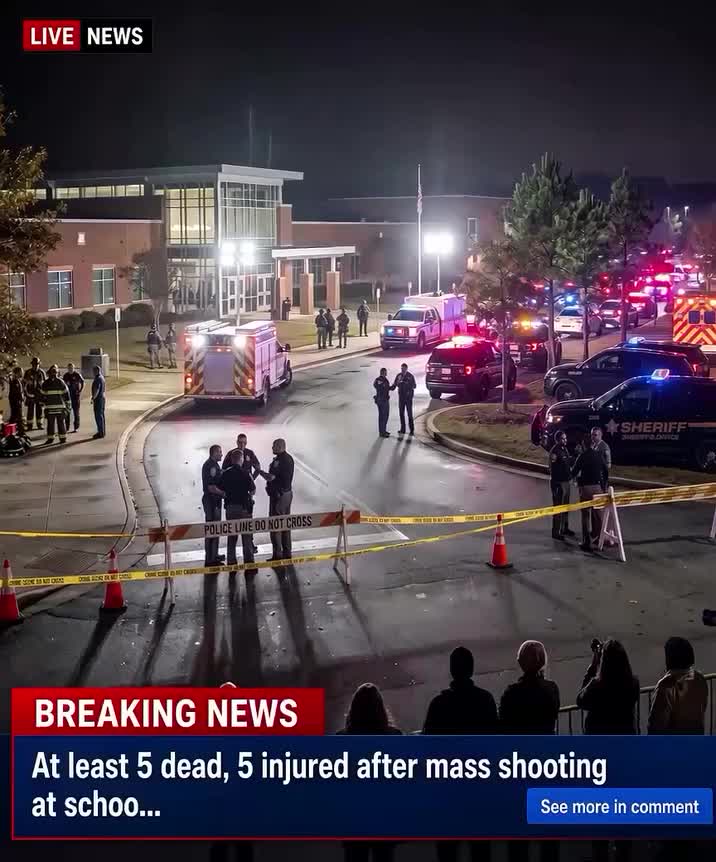
A Facebook reel says that five people died and five were injured in a mass shooting. The webpage linked by the post gives the story a different description. It explicitly calls the shooting at the suburban high school fictional. That qualification appears in the headline on the linked page and again in its account of what emergency responders supposedly did.
The reel’s wording is written in the style of a news alert. It leads with a casualty count and leaves the location and circumstances to the reader’s imagination. The linked page uses several details a reader might recognize from legitimate news reports, including parents arriving for information and emergency crews responding. In this instance those details are parts of the fictional account. The webpage provides no basis for treating them as observations of a real school or real victims.
That distinction is important because the first few words of a social video can reach more people than the article link. Some viewers receive the video in a group chat. Others encounter it with the sound off or as a screenshot. When the qualification appears only after clicking through, a reader who sees the clip by itself may understandably assume the location was omitted for brevity. Here the wording on the linked article resolves that ambiguity by disclosing that the event is invented.
For anyone who received the clip from a friend, the simplest way to explain it is to point to the linked article’s own description. There is no need to speculate about which school the footage might show or to match the casualty number against every recently reported shooting. Many real incidents can share a similar number. A matching number would establish very little about the origin of this reel.
Visuals can introduce a separate question. A person may see an emergency vehicle, a building or a crowd and assume all three came from a single incident. The article’s disclosure does not identify the provenance of every visual in the video. It establishes that the incident as narrated in the accompanying article is fictional. The footage would need its own identifying information to support claims about what it actually depicts.
When a report concerns a possible emergency close to home, check an identifiable school district, an emergency management office or local law enforcement for the location in question. An emergency notice typically names the affected area and gives relevant instructions. An unnamed fictional scenario can evoke the same emotions without providing any facts that help someone establish whether an emergency is happening in their community.
The reel remains a useful example of how framing changes the meaning of a story. Numbers and urgent typography make the clip look like a report about people harmed at a school. The page to which it directs readers calls the scene fictional and describes its responders as part of that scenario. Those words are the decisive evidence for interpreting this particular reel. The casualty figures belong to the fictional story, and the post provides no verified report that five people died at a real school.
