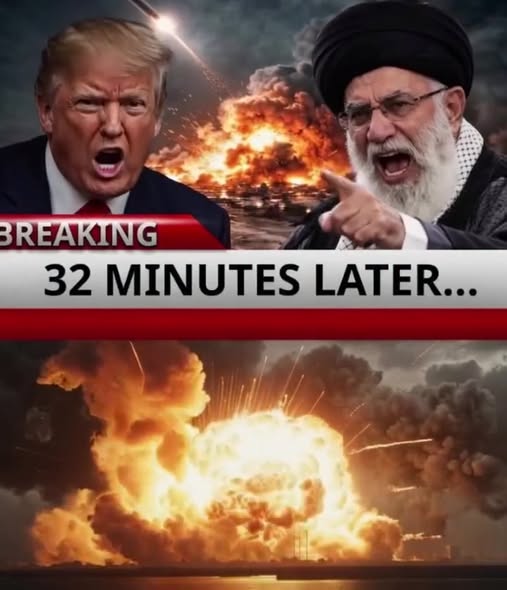
The headline sounds like something from a Hollywood war movie:
Iran tried to sink a U.S. aircraft carrier—and just 32 minutes later, everything changed.
But when dramatic claims like this begin spreading online, there is an important question that should come before the excitement:
What can actually be confirmed?
The United States and Iran are currently locked in a serious military confrontation, with fighting and tensions surrounding the Strait of Hormuz and other parts of the region. Iran has issued warnings about military escalation and has threatened action against the U.S. naval blockade. (Reuters)
At the same time, a new American aircraft carrier, the USS George Washington, has arrived in the Middle East as the USS Abraham Lincoln prepares to leave after an extraordinarily long deployment. (AP News)
Those facts alone are significant.
But the dramatic claim that Iran attempted to sink an American carrier at a specific moment—and that a major event happened exactly 32 minutes later—requires evidence that has not been established by the reliable sources currently available.
That doesn’t make the broader situation unimportant.
Aircraft carriers are among the most heavily protected military platforms in the world.
A carrier does not operate alone. It normally forms the centerpiece of a carrier strike group surrounded by other warships, aircraft and defensive systems.
The purpose is straightforward: protect the carrier from threats arriving by air, sea or underwater.
That makes any alleged attack on a carrier an extraordinarily serious claim.
An attempt to strike one would potentially represent a major escalation, particularly during an already dangerous conflict.
For that reason, claims about such an event should be supported by official statements, multiple reputable news organizations or other independently verifiable evidence.
At the time of writing, those sources have not confirmed the specific “32 minutes later” scenario described in the viral headline.
Even without that particular claim, the military situation is tense.
Iran has warned that it could escalate if the United States does not honor an interim agreement, with an Iranian official telling Reuters that Tehran could take military measures intended to challenge the U.S. naval blockade. (Reuters)
The Strait of Hormuz is especially important.
The waterway is one of the world’s most strategically significant shipping routes, and disruptions there can affect energy markets far beyond the Middle East.
Recent reporting says shipping traffic through the strait remains limited, while tensions between Washington and Tehran continue. (AnewZ)
That means even relatively small military incidents can have consequences far beyond the ships directly involved.
One of the most important confirmed developments this week is the arrival of the USS George Washington in the Middle East.
U.S. Central Command said the carrier strike group entered the CENTCOM theater after arriving in the region on Wednesday. (Arab News)
The arrival is significant because it is intended to relieve the USS Abraham Lincoln.
