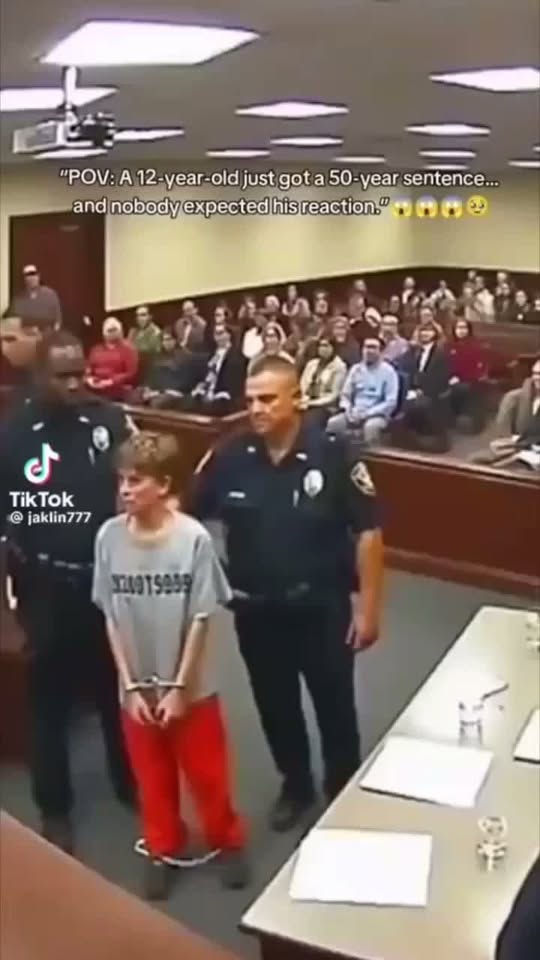
The first scream shattered the silence of the courtroom. It wasn’t just loud—it was raw, desperate, and filled with a level of fear that no one present could ignore.
For a brief moment, everything stopped.
The judge had just finished delivering a sentence that would keep a 12-year-old boy behind bars for decades. The words echoed through the courtroom, carrying a weight that seemed impossible for someone so young to comprehend. Yet in that instant, the reality became painfully clear to him.
His reaction was immediate.
He cried out in disbelief, his voice trembling as panic overtook him. The carefully controlled atmosphere of the courtroom dissolved as the child struggled to process what he had just heard. This wasn’t a rehearsed performance or an attempt to gain sympathy. It was the natural response of a frightened child facing a future that suddenly seemed endless.
The courtroom had seen difficult cases before. Judges, attorneys, and court staff were accustomed to emotional moments. But there was something profoundly unsettling about witnessing such a young person react to a punishment usually associated with adults.
Many of those present later described the scene as unforgettable.
The boy had entered the courtroom dressed neatly, appearing smaller than his age. Throughout the proceedings, he sat quietly beside his legal team, occasionally glancing toward family members seated behind him. Observers noted that he appeared nervous, but no one could have predicted the emotional outburst that would follow the sentencing decision.
When the judge announced the length of the sentence, the significance of those numbers seemed to hit him all at once.
Years.
Decades.
A large portion of his life.
For many adults, even imagining such a sentence is overwhelming. For a child barely entering adolescence, it can feel almost impossible to understand.
As the realization sank in, tears filled his eyes. His breathing became rapid. Then came the scream that echoed through the courtroom and left everyone frozen in place.
Some spectators lowered their heads.
Others wiped away tears.
Even seasoned legal professionals appeared visibly affected by the scene unfolding before them.
The boy repeatedly asked questions through sobs. He wanted to know how long he would be gone. He wanted to know when he could return home. Most importantly, he wanted to understand why his future suddenly looked so different from what he had imagined.
Those questions highlighted a difficult reality at the center of the case.
While courts are tasked with delivering justice, cases involving children often force society to confront uncomfortable questions about accountability, punishment, and rehabilitation. When a child commits a serious crime, determining the appropriate response becomes far more complicated than simply applying standard legal penalties.
Supporters of the sentence argued that the severity of the offense required a serious consequence. They emphasized the impact on victims and their families, noting that justice demands accountability regardless of age.
Others viewed the situation differently.
They pointed to the defendant’s youth, arguing that children are fundamentally different from adults in terms of judgment, impulse control, and emotional development. Neuroscientific research has repeatedly shown that adolescent brains are still developing, particularly in areas related to decision-making and understanding long-term consequences.
For these observers, the image of a terrified 12-year-old crying in a courtroom became symbolic of a larger debate taking place across legal systems around the world.
How should society respond when children commit serious crimes?
Should punishment focus primarily on accountability?
Or should rehabilitation and the possibility of change play a greater role?
The courtroom scene reignited those questions.
Outside the courthouse, reactions were equally divided.
News of the sentencing spread quickly. Media coverage focused heavily on the boy’s emotional response, and public discussion soon followed. Some people expressed sympathy for the child despite the seriousness of the case. Others insisted that emotions should not distract from the facts surrounding the offense.
Social media became a battleground of opinions.
Comments ranged from outrage to compassion.
Some users argued that the sentence was necessary to protect society and honor victims. Others questioned whether anyone so young could truly understand the consequences of their actions in the same way an adult would.
Legal experts weighed in as well.
Many noted that juvenile justice systems exist precisely because lawmakers have long recognized developmental differences between children and adults. Historically, juvenile courts were designed with rehabilitation in mind, emphasizing education, treatment, and reintegration into society.
However, particularly serious offenses have often led to exceptions.
