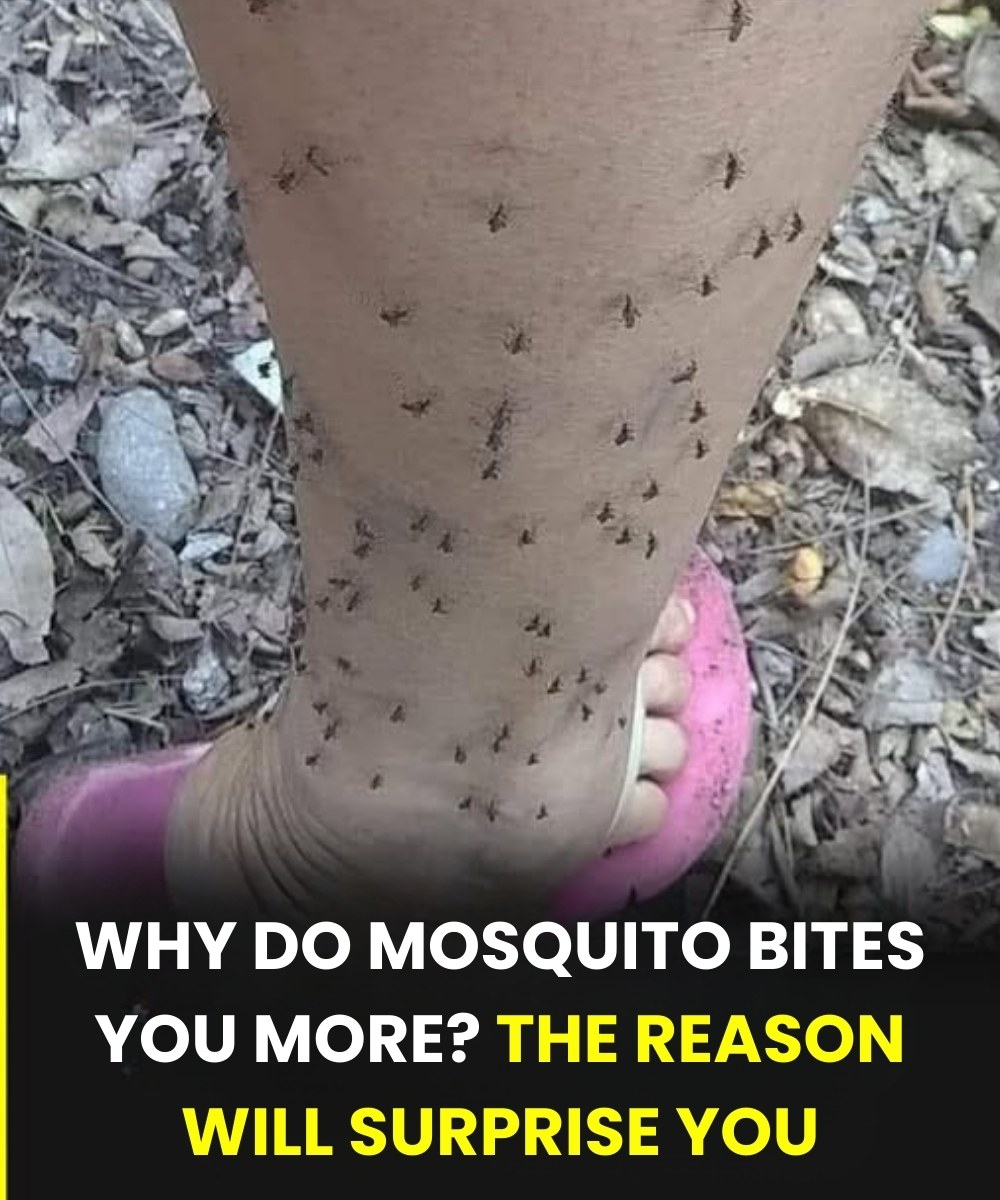
Almost everyone has experienced it at least once. A group of friends gathers outside on a warm evening. The mood is relaxed, conversation flows easily, and everything seems perfect—until the gathering ends. One person walks away scratching, arms and legs dotted with itchy red marks, while others appear completely unaffected. Repellent may have been applied. Long sleeves may have been worn. Precautions may have been taken. Yet the result is always the same.
It often leads to a familiar conclusion: mosquitoes seem to choose favorites.
This perception is not based on coincidence or imagination. Scientific research has consistently shown that mosquitoes do not bite humans randomly. Instead, they rely on a complex combination of biological signals, chemical cues, and environmental factors to decide where to land and who to bite. Some people, through no fault of their own, naturally send stronger signals that mosquitoes are especially good at detecting.
Understanding why this happens can help explain uneven mosquito bites and offer insight into how attraction works at a biological level.
Mosquito Behavior Is Purposeful, Not Random
To understand mosquito preferences, it is important to know that not all mosquitoes bite humans. Only female mosquitoes feed on blood, and they do so for a specific biological reason. Blood provides essential nutrients that help them produce and develop eggs. Without this blood meal, reproduction would not be possible.
Over thousands of years, mosquitoes have evolved highly sensitive sensory systems designed to locate suitable hosts as efficiently as possible. This evolution has resulted in a remarkable ability to detect subtle changes in the environment that signal the presence of a potential blood source.
Humans, without realizing it, constantly release these signals.
The Invisible Signals the Human Body Releases
The human body is continuously emitting chemical and physical cues into the surrounding air. These cues are undetectable to other people but highly noticeable to mosquitoes. From exhaled breath to skin temperature, each signal contributes to how visible a person is to insects.
Some individuals naturally produce stronger versions of these cues. As a result, mosquitoes are more likely to locate them first, return to them repeatedly, and ignore others nearby.
Carbon Dioxide: The Primary Beacon
Among all the signals humans emit, carbon dioxide (CO₂) is one of the strongest and most influential when it comes to mosquito attraction. Every time a person exhales, carbon dioxide is released into the air. Mosquitoes can detect this gas from significant distances and use it as a directional guide.
People who produce more carbon dioxide are easier for mosquitoes to locate. Several factors influence how much CO₂ a person emits, including body size, height, metabolism, and activity level.
Individuals with larger bodies or higher metabolic rates tend to release more carbon dioxide simply because their bodies require more oxygen. Similarly, people who are physically active, breathing faster or deeper, increase the amount of CO₂ in the air around them. This creates a clear trail that mosquitoes can follow with remarkable accuracy.
Body Heat and Temperature Gradients
Carbon dioxide alone does not explain everything. Once mosquitoes move closer to a potential host, they rely on body heat to guide their final approach. Humans naturally generate heat, and mosquitoes are sensitive to temperature differences between skin and surrounding air.
People with slightly higher skin temperatures may be easier targets. This does not necessarily mean someone has a fever or is unwell. Normal variations in circulation, clothing choice, and environmental exposure can affect how warm a person appears to mosquitoes.
Heat acts as a confirmation signal, helping mosquitoes distinguish between living hosts and other carbon dioxide sources.
The Role of Skin Chemistry and Natural Odor
Every human has a unique chemical signature. This signature is created by a combination of natural body odor, skin secretions, and the microorganisms that live on the skin’s surface.
Human skin is home to millions of bacteria. These bacteria interact with sweat and oils, producing specific chemical compounds that contribute to personal scent. While humans may not notice these differences, mosquitoes are extremely sensitive to them.
Certain combinations of these compounds are more attractive to mosquitoes than others. This attraction is not related to hygiene or cleanliness. Even freshly washed skin continues to produce chemical cues once bacteria resume normal activity.
In fact, studies suggest that people with higher diversity or specific types of skin bacteria may be more appealing to mosquitoes, regardless of personal grooming habits.
Why Cleanliness Does Not Prevent Bites
A common misconception is that mosquitoes prefer people who are unclean or sweaty. While sweat plays a role in attraction, cleanliness itself is not a protective factor. Showering may temporarily reduce odor, but it does not eliminate the natural chemical processes that mosquitoes detect.
Within minutes or hours, skin resumes releasing scent compounds. These natural odors are part of normal human biology and cannot be completely removed.
Blood Type and Mosquito Preference
Scientific research has identified a connection between blood type and mosquito behavior. Studies indicate that mosquitoes show a preference for certain blood types over others.
People with type O blood tend to receive more mosquito bites, while those with type A often experience fewer. Types B and AB fall somewhere in between. Researchers believe this may be due to subtle chemical markers released through the skin that make blood type detectable to mosquitoes.
Some individuals naturally secrete substances that signal their blood type more clearly, increasing their attractiveness regardless of other factors.
