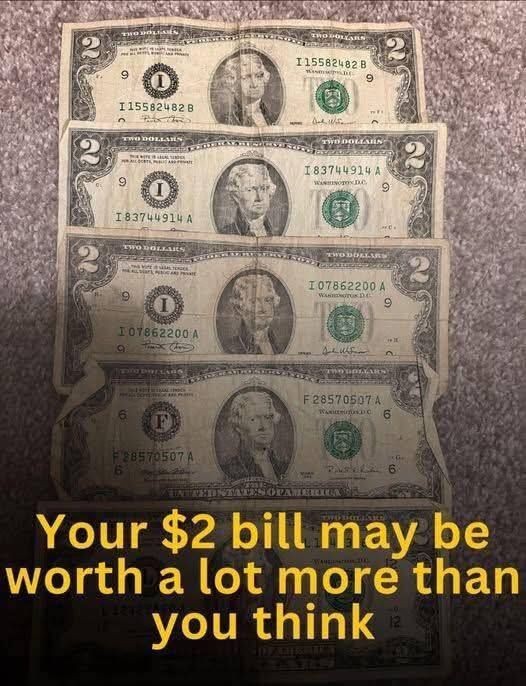
For decades, the humble $2 bill has carried a strange reputation — one part superstition, one part mystery, and a dash of misunderstanding. Once dismissed as bad luck or even cursed, the $2 bill has now become one of the most intriguing pieces of U.S. currency. What used to be overlooked and shoved aside might actually be worth hundreds or even thousands of dollars, depending on what’s printed on it.
Most people think $2 bills are rare or even out of circulation. In reality, they’ve never been discontinued — they’re just uncommon. The reason you don’t see them often is simple: people hoard them. Every time someone gets one in change, they assume it’s a collector’s item and stash it away in a drawer. Ironically, that habit is what makes them feel rare. As of 2025, there are still more than a billion $2 bills in circulation, but they’re spread thin because so few are used day to day.
The origins of the superstition go back to the early 20th century. Many gamblers, particularly in horse racing circles, believed $2 bills were bad luck because that was the standard minimum bet at the tracks. Losers often associated their bad runs with the bills themselves. Business owners also disliked them because cash registers and wallets weren’t designed to fit them neatly, and customers didn’t like getting them in change. For a while, some people even tore off a corner of the bill to “break the curse.” Naturally, those damaged notes lost all collector value — which is a shame, considering what some of the surviving bills are worth today.
The first $2 bills were issued in 1862 during the Civil War. They featured a portrait of Alexander Hamilton, not Thomas Jefferson, who appears on them now. In 1869, Jefferson replaced Hamilton, and the reverse side showed Monticello — Jefferson’s Virginia home — in intricate detail. Over the years, several redesigns came and went, but the overall look of the $2 bill hasn’t changed much since 1976, when it was reintroduced to commemorate the U.S. Bicentennial. That version, featuring the signing of the Declaration of Independence on the back, is still the one used today.
The 1976 release was meant to revive interest in the denomination, but it backfired. People thought it was a special commemorative note and refused to spend it. Many banks handed them out for the Bicentennial celebrations, and most recipients promptly tucked them away as souvenirs. So instead of entering circulation, they ended up in collections, drawers, and scrapbooks. Decades later, those same “souvenirs” might be sitting unnoticed — worth far more than two dollars.
So, what makes a $2 bill valuable? It comes down to rarity, serial numbers, printing errors, and condition. Certain runs of $2 bills, especially older ones printed before 1918, can fetch serious money. For example, a 1928 red-seal $2 bill in uncirculated condition can sell for anywhere from $100 to $500. Notes with unique serial numbers — like repeating patterns (e.g., 12341234), ladders (e.g., 12345678), or low numbers (00000005) — can command hundreds more. A bill with a star next to its serial number, known as a “star note,” signals it replaced a misprinted one at the Bureau of Engraving and Printing. Those are especially valuable to collectors.
But even modern $2 bills can surprise you. A 1976 note with a special stamp postmarked on April 13, 1976 — the day of issue — can sell for $50 or more. Certain bills from the 2003 and 2013 series with rare misprints or unique serials have gone for thousands. One example: a misaligned 1976 bill with a double serial number sold for over $2,000 at auction. Condition matters immensely, too. A crisp, uncirculated bill kept flat and clean is always worth more than one that’s been folded, torn, or marked.
