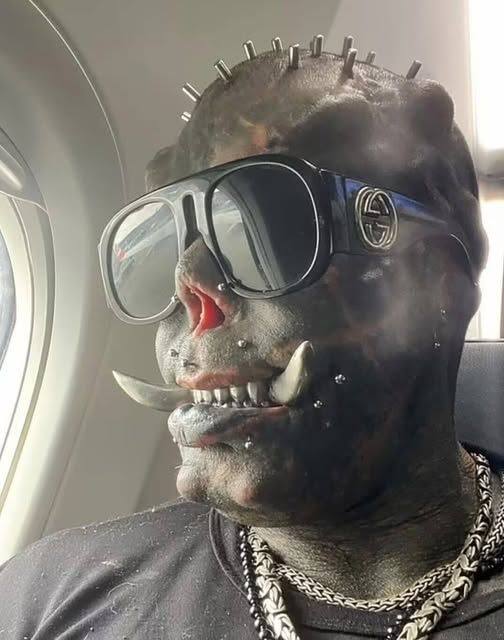
Body modification has existed across cultures for thousands of years, from traditional tattoos and piercings to ritual scarification and symbolic adornment. In modern times, these practices have expanded into more extreme forms, often sparking intense public debate. One of the most discussed figures in this space is Brazilian tattoo artist Diabao Praddo, a man whose appearance and personal philosophy have drawn global attention and controversy.
Once known simply as Michel, Praddo has chosen a path of physical transformation that goes far beyond conventional body art. Over the years, he has undergone numerous procedures that have significantly altered his appearance, leading to his widely recognized nickname, the “Human Satan.” Recently, Praddo revealed images and stories from his life before these changes, offering a rare glimpse into how dramatically his identity has evolved.
This is not merely a story about appearance. It is also a story about self-expression, personal autonomy, partnership, and the boundaries of identity in a modern world that is constantly redefining what it means to be human.
A Recent Step in an Ongoing Transformation
At the age of 50, Diabao Praddo continues to pursue what he describes as a lifelong transformation project. In one of his most recent procedures, he chose to remove two additional fingers from his left hand. The result is a hand shape that he says aligns more closely with his long-term vision of becoming an “alien-like” figure.
According to Praddo, this change was not impulsive. Instead, it was a carefully considered decision that fits into a broader artistic and philosophical framework he has followed for many years. He views his body as a living sculpture—one that evolves through deliberate and permanent choices.
While such decisions naturally raise concerns among medical professionals and the general public, Praddo maintains that each procedure was performed with planning and intent. He acknowledges the physical challenges involved but emphasizes that his focus has always been on transformation rather than shock value.
From Michel to Diabao: A Life Reimagined
Before becoming internationally known, Praddo lived a relatively ordinary life. Photographs from his earlier years show a man who looked much like anyone else, with no visible signs of the radical changes that would later define him. Over time, however, he began exploring body art as a form of deeper self-expression.
What started with tattoos gradually expanded into more extensive modifications. For Praddo, each step represented a departure from his former identity and a movement toward something new. He eventually adopted the name “Diabao,” symbolizing the persona he was creating through these changes.
Today, approximately 85 percent of his body is covered in tattoos, forming a dense and intricate visual narrative across his skin. These designs are not random; they are part of a cohesive aesthetic that reflects his internal vision and long-term goals.
Record-Breaking Modifications and Public Attention
One of the most widely reported aspects of Praddo’s appearance is his collection of subdermal horn implants. He currently holds a Guinness World Record for having the highest number of these implants on his head—33 in total. The implants create a striking silhouette that has become one of his most recognizable features.
This record has brought international attention, but Praddo insists that recognition was never the primary motivation. Instead, he sees the record as a byproduct of his commitment to personal transformation rather than a goal in itself.
Public reaction to his appearance has ranged from fascination to criticism. Some see his choices as an extreme form of art, while others question the limits of body modification. Praddo acknowledges these reactions but remains firm in his belief that individuals should have autonomy over their own bodies, provided their choices do not harm others.
Continuing His Career Despite Physical Challenges
One of the most practical concerns surrounding Praddo’s transformations has been their impact on his profession. As a tattoo artist, his hands are essential tools. Before undergoing major changes to his fingers, he worried that his ability to work might be permanently affected.
Surprisingly, he found that adaptation was possible. Over time, he learned new techniques and adjusted his movements to continue tattooing effectively. While the process required patience and persistence, Praddo says it reinforced his belief in human adaptability.
He has spoken openly about experiencing discomfort, including sensations often described by people who undergo significant physical changes. Rather than viewing this as a deterrent, he considers it part of the broader reality of transformation and personal choice.
