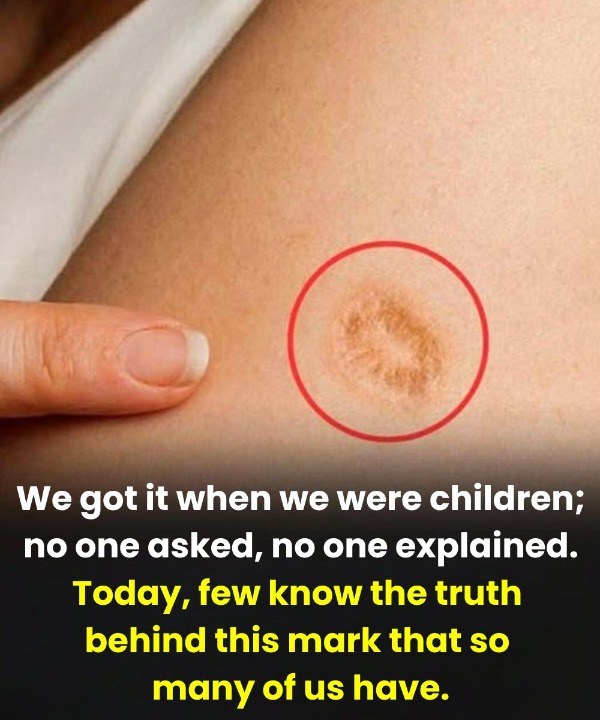
Across large parts of the world, millions of people grow up carrying a small, circular mark on their upper arm. It is usually pale or slightly raised, often no bigger than a coin. For many, it is something they barely notice during childhood, only to become curious about it later in life.
Some people discover the mark as teenagers or adults and begin to question its origin. Others notice it when comparing arms with friends or family members. In some cases, the scar becomes a source of embarrassment or confusion, especially when no one ever explained what it was or why it appeared.
Over the years, this tiny scar has accumulated a surprising amount of misunderstanding. Stories are invented, assumptions are made, and myths are passed from one generation to the next. In reality, the explanation is far simpler—and far more ordinary—than many people realize.
This article explores the most common misconceptions surrounding the small round scar and explains what it actually represents. In doing so, it aims to replace confusion with clarity and stigma with understanding.
A Mark Seen Around the World
If you grew up in parts of Asia, Africa, Latin America, the Middle East, or Eastern Europe, there is a strong chance you recognize this scar. It typically appears on the upper arm, often on the left side, and has been present for as long as the person can remember.
Unlike scars caused by accidents, it does not come with a story of a fall, a cut, or a burn. There is no dramatic memory attached to it. For many, it simply “has always been there.”
Because of this lack of explanation, the scar has become a blank canvas onto which people project their own theories. Some believe it signals illness. Others assume it reflects social status, upbringing, or even personal health problems. None of these assumptions are accurate.
To understand the truth, it helps to examine the most widespread misconceptions one by one.
Misconception One: “It Must Be a Skin Condition or Childhood Injury”
One of the most common assumptions is that the round scar resulted from a skin disease, an infection, or some kind of childhood accident. People sometimes guess it came from a boil, a rash, or even a minor burn.
Because the scar is circular and distinct, it can look unusual to those unfamiliar with it. Without context, it is easy to imagine that it was caused by something going wrong rather than something done intentionally.
The Reality
In the vast majority of cases, this scar is the result of the BCG vaccine, which has been used for decades to protect against tuberculosis (TB). The vaccine is commonly administered during infancy or early childhood in countries where TB prevention is part of national health programs.
The mark forms as part of the body’s natural response to the vaccine. It is not a sign of injury, infection, or disease. Instead, it reflects a normal immune reaction that occurred many years earlier.
Importantly, the presence of the scar does not mean something went wrong during vaccination. On the contrary, it indicates that the body responded as expected at the time.
Misconception Two: “Only People from Poor or Rural Backgrounds Have It”
Another persistent myth is that the scar signals poverty, poor living conditions, or lack of access to proper healthcare. In some social settings, people incorrectly associate the mark with underdevelopment or neglect.
This belief can be especially harmful, as it attaches unnecessary judgment to something that is entirely unrelated to a person’s background or circumstances.
The Reality
The BCG vaccine has historically been part of nationwide public health strategies, not selective or informal medical practices. It was administered to children across entire populations, including those from urban areas, rural communities, wealthy families, and middle-class households.
The decision to use the vaccine was based on public health priorities, not individual economic status. In many countries, it was considered a routine and responsible measure to protect children during early life.
Having the scar says nothing about a person’s upbringing, hygiene, or access to care. It simply reflects the health policies that were in place at the time and location where they were born.
