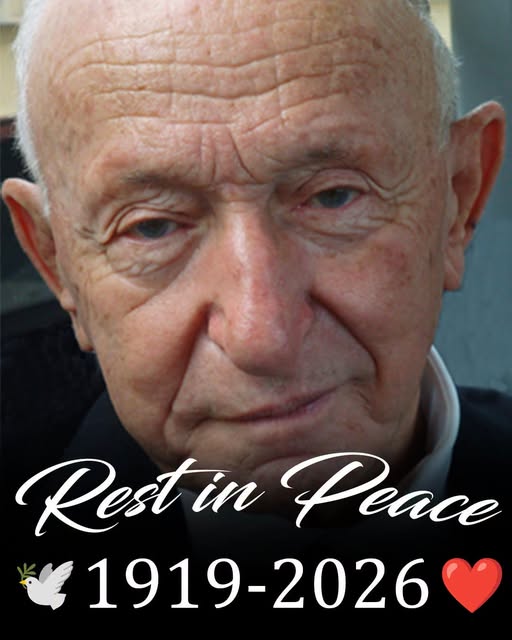
The horrors inflicted by the Nazis on millions of innocent people can sometimes feel like they belong to another lifetime.
But the people who survived them are still among us — carrying memories that must never be forgotten.
Now, another remarkable voice from that generation has fallen silent.
The final transport
Yehuda Aharon Widawski, one of Israel’s oldest Holocaust survivors, has died at the age of 107. He survived Auschwitz and Nazi forced labor, lost much of his family during the Holocaust, and spent the decades that followed doing something profoundly meaningful: preserving the memory of the Jewish communities the Nazis had tried to destroy.
His life was, in many ways, a testament to survival.
Born in 1919 in the Polish town of Turek, Widawski grew up in a religious Jewish family before moving with his family to Łódź as a teenager. There, the family operated a textile business.
When Nazi Germany invaded Poland and the Jewish population of Łódź was forced into the ghetto, Widawski and members of his family were confined there together.
On August 29, 1944, the final transport from the Łódź Ghetto left for Auschwitz-Birkenau. Widawski’s parents, Abraham and Dobrish-Leah, were murdered there along with his older brother Gabriel. His brother Chaim Moshe was later murdered at Buchenwald, while his sister Yocheved was killed at Stutthof.
Only Yehuda and his brother Yehoshua survived the selection at Auschwitz.
Wikipedia Commons / xiquinhosilva
The brothers were eventually transferred to the Friedland forced labor camp near Breslau, where prisoners were forced to assemble aircraft wings for the Germans.
Widawski once recalled that when prisoners were asked about their professions, most claimed to be engineers or factory workers in hopes of improving their chances of survival.
He alone told the truth.
“I was convinced that honesty would cost me my life,” he recalled during an interview with Ynet.
Instead, something unexpected happened.
The German manager reportedly shouted: “You are all liars. There is only one honest man here. Give him a double portion of hot food.”
Widawski eventually became an informal leader among the prisoners. When the Germans increased their production quota, he devised a clever system that allowed the prisoners to hide completed aircraft wings and use them to make up for shortages, helping protect the group from punishment.
But survival came at an enormous physical cost.
Wikipedia Commons / M Z Wojalski
“Every day we walked nine kilometers each way,” Widawski recalled. “It was terrible, but we lived with the hope that we would get through it.”
That hope carried him to May 9, 1945, when Soviet forces liberated the camp.
After the war, Widawski returned to Łódź, married Dobrish Wassercug, and began rebuilding his life. Their son Avraham was born in Poland.
In 1950, the family immigrated to Israel and settled in Tel Aviv, where their daughter Leah was born.
But Widawski never forgot the people and places he had left behind.
Nearly three decades later, in 1978, he returned to Poland for the first time since the war. He had gone searching for his grandmother’s grave.
What he found would change the course of the rest of his life.
Jewish cemeteries had been devastated, neglected and forgotten. The communities that had once filled Polish cities with Jewish life had been almost completely destroyed.
Widawski began working to restore what remained.
At the Jewish cemetery in Łódź, he used historical records to identify graves and helped restore more than 3,000 of them. He also traveled repeatedly throughout Poland, helping locate Jewish graves and preserve cemeteries and sites of memory.
Wikipedia Commons / David Shankbone
What began as a search for one family member’s grave became a lifelong mission.
