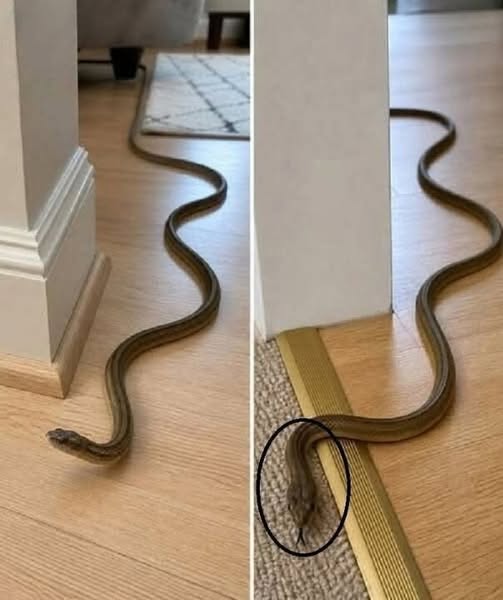
Finding a snake inside a home can be a startling and emotionally intense experience for most people. Even individuals who generally feel calm around wildlife often react with surprise, fear, or confusion when encountering a snake in an unexpected indoor space. Whether the sighting occurs in a kitchen, garage, basement, garden shed, or even a living room, the moment tends to leave a strong impression and is often remembered for years afterward.
In many cultures, snakes carry symbolic meanings that have been passed down through generations. Some traditions associate them with transformation, others with danger, and some even interpret their appearance as a sign of luck or misfortune. These interpretations, however, belong to folklore and belief systems rather than scientific understanding. There is no verified evidence that a snake entering a home has any spiritual or predictive meaning related to a person’s future, financial status, or personal life events.
From a biological and ecological perspective, snakes are not mysterious intruders acting with intention toward humans. They are animals responding to environmental conditions and survival needs. When a snake is found indoors, it is almost always due to practical factors such as the search for food, shelter, temperature regulation, or accidental movement through accessible entry points. Understanding these reasons can significantly reduce fear and help people respond in a safer, more informed way.
This article explores in detail why snakes may enter residential spaces, what attracts them, how they behave, and what steps can be taken to prevent encounters. It also explains how to react calmly and responsibly if a snake is discovered inside or near a home.
Understanding Snake Behavior Around Human Spaces
One of the most common misunderstandings about snakes is the idea that they actively seek out human beings or intentionally invade homes. In reality, snakes do not recognize humans as a target or objective. Their behavior is driven almost entirely by survival instincts rather than curiosity or aggression.
Most snake species naturally prefer to avoid human contact. Humans are large predators in the eyes of wildlife, and snakes typically rely on concealment and retreat as their primary defense mechanism. When given the opportunity, they will usually move away quietly rather than confront or engage.
If a snake is found inside a building, it is rarely because it intentionally entered the space with purpose. Instead, it is more likely that it moved through an open or unnoticed passage while following environmental cues such as warmth, scent trails of prey, or shelter opportunities. In some cases, the snake may have entered accidentally and become disoriented.
Understanding this behavior helps reduce panic. A snake indoors is not acting out of malice or targeting people; it is simply trying to survive in an environment that may have become accessible to it.
