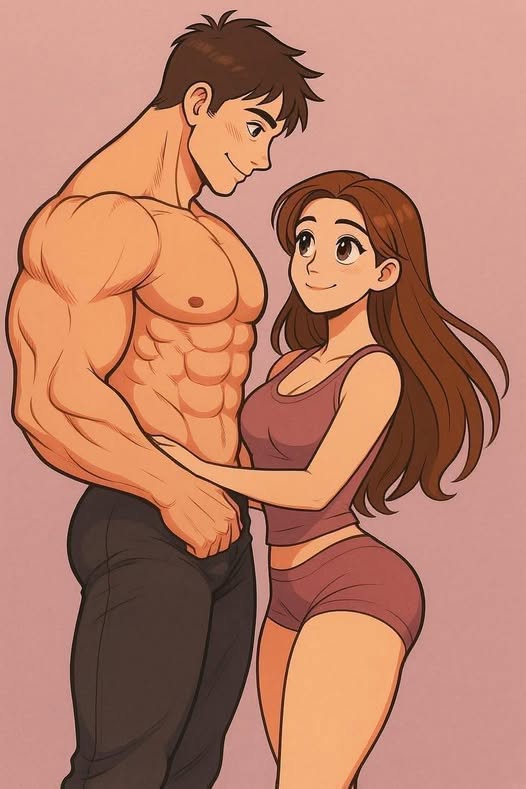
Beneath the surface of casual conversations about attraction, compatibility, or “having a type,” there are often deeper psychological currents at work that people rarely articulate directly. Preferences in romantic attraction are frequently described as simple personal taste, something as straightforward as liking a certain eye color or enjoying a particular style of clothing. Yet when examined more closely, especially in something as symbolically loaded as height difference, these preferences can begin to reveal subtle ideas about identity, power, emotional safety, and self-image.
Height, in particular, carries meanings that extend far beyond physical measurement. Across cultures and social settings, it is often unconsciously associated with presence, dominance, confidence, protection, and authority. A taller body can be interpreted—fairly or not—as occupying more space in a room, drawing attention more easily, and projecting a sense of control or composure. Conversely, shorter stature is frequently linked, again through social conditioning rather than inherent truth, with approachability, softness, youthfulness, or gentleness. These associations are not fixed realities, but cultural interpretations layered onto physical differences over time.
When people express preferences regarding height in romantic partners, they are often engaging with these cultural symbols without fully realizing it. What appears to be a simple statement of attraction can sometimes reflect more complex emotional narratives that sit just below conscious awareness. For many men, for instance, attraction related to a partner’s height can become intertwined with questions about self-worth, masculinity, or emotional security. For others, it may be tied to admiration, curiosity, or the desire for a relationship dynamic that feels different from their everyday sense of self.
In this context, the preference for a taller woman can sometimes carry symbolic meaning beyond physical attraction. Tall women are often perceived as carrying a kind of natural authority or presence. In social imagination, they may be viewed as confident, ambitious, or even commanding without needing to speak. This perception can create a psychological dynamic where attraction is shaped not just by appearance, but by what that appearance represents. A man drawn to a taller woman might be responding to an impression of strength or independence that he finds compelling, aspirational, or even challenging.
That challenge can take many forms. For some, it may be admiration for confidence they feel they lack. For others, it may be a desire to engage with a partner who feels like an equal in presence or status, someone who does not diminish their sense of identity but instead expands it. In certain cases, attraction to a taller partner can also reflect a subtle form of internal competition, where admiration and insecurity coexist. The presence of someone who stands out physically can evoke both fascination and introspection, prompting questions about one’s own role, confidence, or place within a relationship.
At the same time, attraction is rarely one-dimensional. Even when symbolic meanings are present, they are interwoven with personal experience, emotional needs, and individual history. A person may be drawn to a taller partner simply because of a unique moment of connection, shared humor, intellectual compatibility, or emotional resonance. The symbolic layer of height is only one thread among many, and it does not fully define the relationship. Still, it can subtly influence how the relationship is initially perceived or how it is emotionally framed over time.
On the other side of this spectrum, shorter women are often socially interpreted through a different set of assumptions. These assumptions are not universal truths, but rather patterns that emerge from cultural storytelling and repeated representation. Shorter stature is frequently associated with qualities such as warmth, gentleness, or emotional accessibility. In romantic imagination, this can translate into an image of someone who feels comforting to be around, someone who may appear more approachable or nurturing.
A man drawn to a shorter partner might therefore be engaging, consciously or unconsciously, with the idea of emotional ease. This does not mean the attraction is based on a desire for dependency or imbalance; rather, it may reflect a longing for relational softness, stability, or a sense of being emotionally accepted without pressure. For some, it can be about stepping away from external expectations of strength or performance and entering a dynamic where vulnerability feels more permissible.
However, these interpretations can also become overly simplified if taken too literally. It is important to recognize that no physical trait inherently determines personality, emotional capacity, or relational behavior. Short women are not inherently more nurturing, just as tall women are not inherently more dominant or assertive. These are symbolic associations created by culture, media, and repeated social narratives. When individuals internalize these associations too strongly, they risk reducing complex human beings into categories that may not reflect reality.
What is more accurate is to understand that people often project meaning onto physical traits as a way of organizing their emotional expectations in relationships. Height becomes a visual shorthand, a way of quickly forming impressions before deeper understanding develops. These impressions may be influenced by past experiences, cultural exposure, or personal insecurities. In this sense, attraction is not only about the other person, but also about the internal world of the one experiencing attraction.
In romantic dynamics, physical differences can also influence how individuals perceive roles within a relationship. Some people feel more comfortable when there is a clear sense of physical contrast, interpreting it as complementary rather than competitive. Others prefer minimal difference, associating it with equality or mutual mirroring. These preferences are often shaped long before adulthood, influenced by family dynamics, early experiences of attachment, or social environments where certain body types were idealized or emphasized.
When a person expresses a desire to “feel smaller” or “feel larger” in relation to a partner, this is often less about physical measurement and more about emotional positioning. Feeling smaller may be associated with safety, surrender, or relief from responsibility. Feeling larger may be associated with protection, control, or reassurance of capability. These emotional interpretations are symbolic and internal, even though they are often described in physical terms.
In the case of height differences, these symbolic meanings become especially visible because height is immediately perceptible. Unlike personality traits, which require time and interaction to understand, height is noticed instantly. As a result, it can become an early organizing factor in attraction, shaping first impressions and initial curiosity. Yet over time, as relationships deepen, the influence of height typically diminishes in comparison to emotional compatibility, communication, shared values, and lived experience together.
Still, it would be inaccurate to dismiss height preferences as meaningless. They do carry psychological weight, but that weight is subjective rather than universal. For one individual, height difference might symbolize protection or grounding. For another, it might represent equality or shared strength. For someone else, it may simply be an aesthetic preference with no deeper interpretation attached. The meaning is not fixed in the trait itself, but constructed by the person experiencing it.
When examining why some individuals feel strongly about height differences, it often becomes clear that these preferences can intersect with deeper themes of identity. For example, someone who feels uncertain about their own social standing may be drawn to a partner whose physical presence appears more commanding, as if proximity to that presence might offer a sense of stability. Conversely, someone who feels overwhelmed by assertive personalities might prefer a partner whose physical presence feels less imposing, creating a sense of emotional ease or balance.
These patterns are not rules, but tendencies that can emerge under certain emotional conditions. Importantly, they do not determine the success or failure of a relationship. Many strong relationships exist with significant height differences, and many equally strong relationships exist without any notable difference at all. What matters more is how individuals interpret those differences and whether they attach rigid expectations to them.
It is also worth noting that attraction is dynamic rather than static. What someone finds appealing at one stage of life may shift significantly over time. Experiences, maturity, confidence, and emotional development all influence how preferences evolve. A person who once prioritized physical traits may later prioritize emotional intelligence, humor, or stability. In this way, height preferences are not fixed identities but changing reflections of internal growth.
At a broader level, societal narratives about gender and physicality can reinforce certain interpretations of height. Traditional portrayals often emphasize taller male figures as protectors and shorter female figures as nurturers. While these narratives persist in some cultural contexts, modern relationships increasingly move beyond them, embracing a wider range of dynamics that do not rely on rigid physical symbolism. As people redefine what relationships mean to them, these older associations gradually lose their dominance, even if they do not disappear entirely.
Ultimately, height in romantic attraction functions less as a determinant and more as a symbolic canvas. People project meanings onto it—strength, safety, aspiration, comfort, equality—and those meanings reveal more about the observer than the observed. When someone expresses a preference related to height, they are often indirectly expressing how they wish to feel in a relationship: secure, admired, protected, understood, or balanced.
The complexity lies in the fact that these feelings are rarely singular. A person may simultaneously desire equality and protection, independence and closeness, admiration and comfort. Height becomes one of many symbolic ways these tensions are negotiated internally. It is not the cause of attraction, but one of the many surfaces onto which deeper emotional needs are mapped.
In the end, physical height is simply a biological variation. It carries no inherent moral or emotional value. Yet in human perception, it becomes a story—a way of interpreting presence, relating to identity, and imagining connection. The real significance is not in the number of inches or centimeters, but in the meanings people quietly attach to them. And those meanings, constantly shifting and deeply personal, are what shape the emotional experience of attraction far more than height itself ever could.
