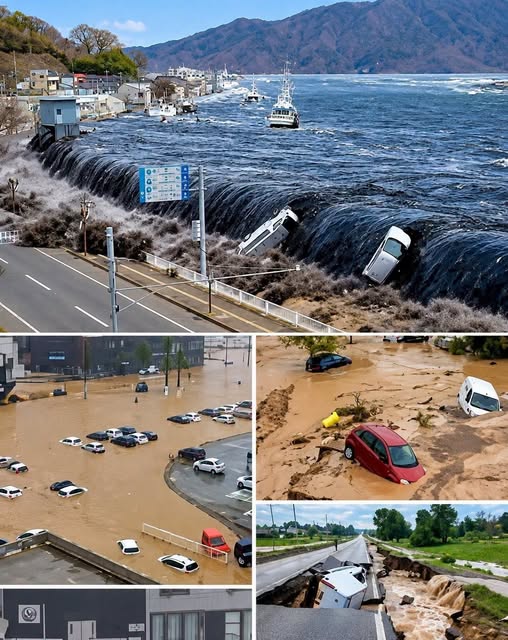
The following is a fictional disaster narrative set in Miyako, Japan. The events, earthquake, tsunami, casualties, and destruction described below are fictional and should not be interpreted as a report of a real earthquake occurring in Miyako.
The Morning the Ground Began to Move
At first, no one in Miyako understood what was happening.
It began with a vibration so subtle that some residents mistook it for a passing truck.
A glass trembled on a kitchen table.
A hanging light swung gently from the ceiling.
A few dishes rattled inside cupboards.
Then the movement became stronger.
The floor shifted beneath people’s feet.
Windows began to shake violently.
Furniture moved across rooms.
And within seconds, the ordinary sounds of morning disappeared beneath the deep, continuous roar of a city being violently shaken.
The fictional earthquake had struck beneath the ocean with an extraordinary magnitude of 9.1.
There was no warning that could prepare people for the force that followed.
In homes throughout the coastal city of Miyako, people grabbed walls, doorframes, tables, anything that might keep them upright.
Some screamed.
Others froze.
Children cried as parents pulled them close.
Shelves collapsed.
Objects fell from walls.
Glass shattered across floors.
Outside, utility poles swayed violently, power lines twisted, and parked vehicles bounced against the pavement.
The shaking seemed to have no end.
For what felt like minutes, the entire world had become motion.
Then, almost as suddenly as it had begun, the strongest shaking weakened.
Silence followed.
Not peaceful silence.
A frightening silence.
The kind of silence that comes when people are waiting to find out what has happened.
Residents slowly stepped outside.
Some stood in the streets looking at damaged buildings.
Others were calling relatives.
Phones rang.
Messages were sent.
But communication networks were already beginning to fail.
And somewhere beyond the coastline, beneath the dark surface of the Pacific Ocean, another danger was already forming.
One far larger than the earthquake itself.
The Warning That Changed Everything
Emergency sirens suddenly began sounding across Miyako.
Their voices echoed through neighborhoods.
Loudspeakers repeated emergency instructions.
Residents were told to move immediately toward higher ground.
A tsunami warning had been issued.
For many people, the meaning was instantly clear.
The earthquake was not the end.
It was the beginning.
A powerful tsunami was moving toward the coast.
People who had spent their lives near the ocean knew what that meant.
They knew that the sea could become something entirely different after a major offshore earthquake.
Parents grabbed children.
Older residents were helped from damaged houses.
People abandoned cars in the streets.
Some took only a coat.
Others grabbed documents, medicine, water, or photographs.
There was no time to pack properly.
There was no time to decide what was important.
The instruction was simple:
Get to higher ground.
And everyone understood that every minute mattered.
The Sea Began to Change
Then something strange happened.
People near the coastline noticed the ocean behaving differently.
The water began pulling away.
At first, it looked almost beautiful.
The shoreline seemed to expand.
Wet sand appeared where water had been moments earlier.
Small boats tilted awkwardly in exposed areas.
Fish were visible in places that were normally underwater.
Some people stopped to stare.
Others began recording.
But those who understood what the retreating water could mean were terrified.
The ocean was not simply disappearing.
It was drawing backward.
Preparing.
The shoreline became strangely quiet.
Then someone shouted:
“Run!”
A distant wall of water was approaching.
The First Wave
It did not look like an ordinary wave.
It was broader.
Darker.
More powerful.
The water advanced across the coast with enormous force.
It reached the seawall.
For a brief moment, the barrier appeared to hold.
Then the water surged higher.
It spilled over.
The sound was deafening.
Water crashed into streets.
Vehicles began moving.
At first, they rolled.
Then they floated.
Then they collided.
A parked car struck another vehicle and spun sideways.
A small truck was pushed across an intersection.
Objects that had been stationary only seconds earlier became dangerous projectiles.
Water poured through low-lying neighborhoods.
Residents who had not evacuated quickly enough ran toward higher ground.
Some climbed staircases.
Others scrambled onto upper floors.
Emergency workers shouted directions through loudspeakers.
The city had become a maze of water, debris, darkness, and panic.
The Road to Higher Ground
One fictional family, the Tanakas, had been eating breakfast when the earthquake struck.
Their apartment shook violently.
Their youngest daughter, Hana, began crying.
Her father grabbed her hand.
Her mother picked up a small emergency bag they had prepared months earlier.
They had never expected to use it.
Now they were running.
They left nearly everything behind.
The elevator was not working.
So they took the stairs.
Downstairs, neighbors were already moving toward the evacuation route.
An elderly man was struggling to walk.
Two younger residents stopped to help him.
Someone shouted that another wave was coming.
The group moved faster.
Hana looked back toward their home.
“Are we coming back?”
Her mother hesitated.
She didn’t know.
Then she said:
“We’re going somewhere safe first.”
It was the only answer she could give.
Behind them, the sound of the ocean grew louder.
A City Without Electricity
The earthquake had damaged electrical infrastructure across parts of the city.
Some areas went dark almost immediately.
Traffic signals stopped working.
Streetlights disappeared.
Buildings that had been brightly illuminated only minutes earlier became dark silhouettes.
Emergency generators activated in some facilities.
Others had no power at all.
Without electricity, everyday systems became suddenly difficult.
Elevators stopped.
Pumps struggled.
Some communications equipment failed.
Residents tried to charge phones from vehicles and portable batteries.
But mobile networks were overloaded.
Thousands of people were trying to contact relatives simultaneously.
Messages remained unsent.
Calls failed.
Some phones showed no signal.
That created a second kind of panic.
People weren’t only afraid of the disaster.
They were afraid for the people they couldn’t reach.
The Search for Missing Family Members
At one evacuation center, a woman named Keiko stood near the entrance holding her phone.
She had been trying to contact her husband for more than an hour.
He had been at work near the waterfront when the earthquake struck.
The last message she received said:
“I’m okay. We’re evacuating.”
Then nothing.
Keiko tried calling.
No answer.
Again.
Nothing.
She walked from one side of the shelter to the other.
Every time someone entered, she looked up.
Every time a phone rang, she hoped it was him.
She wasn’t alone.
All around her, families were waiting.
Some had been separated while evacuating.
Others had elderly parents in different neighborhoods.
Children asked when their fathers or mothers would return.
Volunteers moved through the shelter distributing water.
But there was little information.
The city itself had become difficult to navigate.
Roads were flooded.
Bridges were damaged.
Debris blocked streets.
Emergency crews had to prioritize the most urgent rescues.
For families waiting in shelters, uncertainty became its own kind of suffering.
The Second Wave
Just when some residents began believing the worst had passed, another warning came.
More waves were possible.
The ocean had not returned to normal.
Emergency officials urged everyone to remain away from the coastline.
That instruction was difficult for some people to accept.
They wanted to see their homes.
They wanted to retrieve belongings.
They wanted to know whether their businesses were still standing.
But returning too early could be deadly.
Tsunamis do not necessarily arrive as a single wave.
A later wave can be larger than the first.
And even after the main flooding begins to retreat, dangerous currents can continue.
So emergency personnel repeated the warning:
Stay away from the water.
The coastline was not safe.
